

There’s a certain hush that falls over a garage just before someone turns the key. It’s not silence exactly it’s anticipation wearing overalls.
I remember standing beside my uncle’s old pickup truck as a kid, not tall enough to see over the hood, but tall enough to feel the rumble in my ribs. He didn’t talk about torque curves or gear ratios.
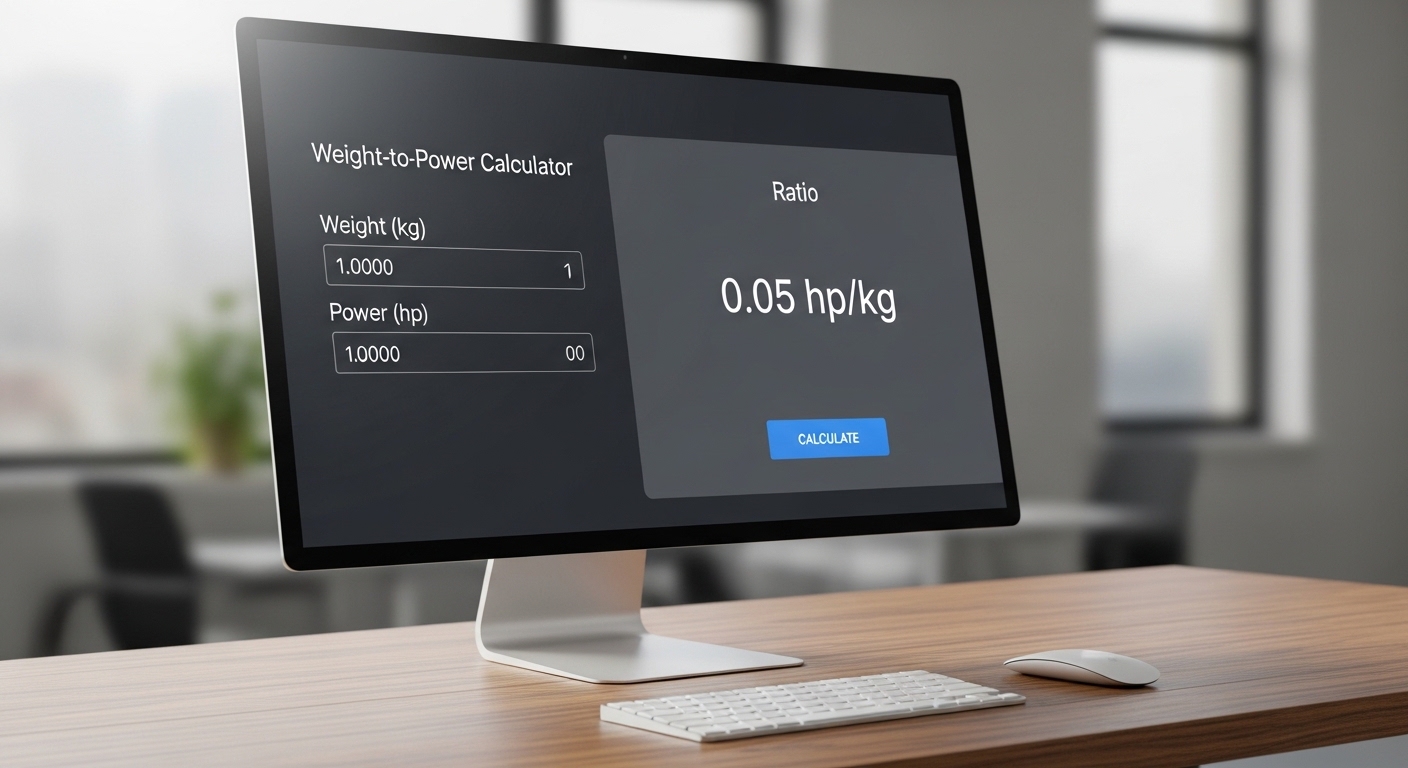
He just grinned and said, “This one’s got guts.” Years later, I learned what he meant wasn’t magic. It was math. Specifically, the beautiful, underappreciated poetry of a Weight to Power Ratio Calculator.
We don’t always call it that at first. Sometimes it’s whispered as the Power-to-Weight Ratio (PWR). Sometimes it shows up dressed more formally as a Power / Weight Performance Metric.
Engineers might say Power to Mass Ratio, because they’re picky about the whole mass vs weight distinction thing and honestly, they’re not wrong.
But whether you’re tuning a hypercar or comparing cycling wattage with your buddy on a Sunday ride, this ratio is the quiet kingmaker of performance.
Let’s wander through it together. Not like a textbook. More like two curious minds leaning over an engine bay, arguing about whether a lighter car with less horsepower might actually outrun something louder and more expensive.
Weight To Power Ratio Calculator – Quick Reference Table
| Vehicle / Example | Engine Power Output | Curb Weight | Power-to-Weight Ratio | Notes |
|---|---|---|---|---|
| Ford Fiesta | 120 hp | 1,150 kg | 0.104 hp/kg | Lightweight daily driver |
| Ford F-Series pickup truck | 400 hp | 2,300 kg | 0.174 hp/kg | Strong but heavy |
| Bugatti Chiron | 1,500 hp | 1,995 kg | 0.752 hp/kg | Extreme hypercar performance |
| Koenigsegg Jesko Absolut | 1,600 hp | 1,390 kg | 1.15 hp/kg | One of the highest ratios |
| Formula 1 car | 1,000 hp | 798 kg | 1.25 hp/kg | Built for racing acceleration |
| Typical Motorbike | 200 hp | 200 kg | 1.00 hp/kg | Very high acceleration potential |
What a Weight To Power Ratio Calculator Really Measures (And Why It Feels Like Cheating Physics)
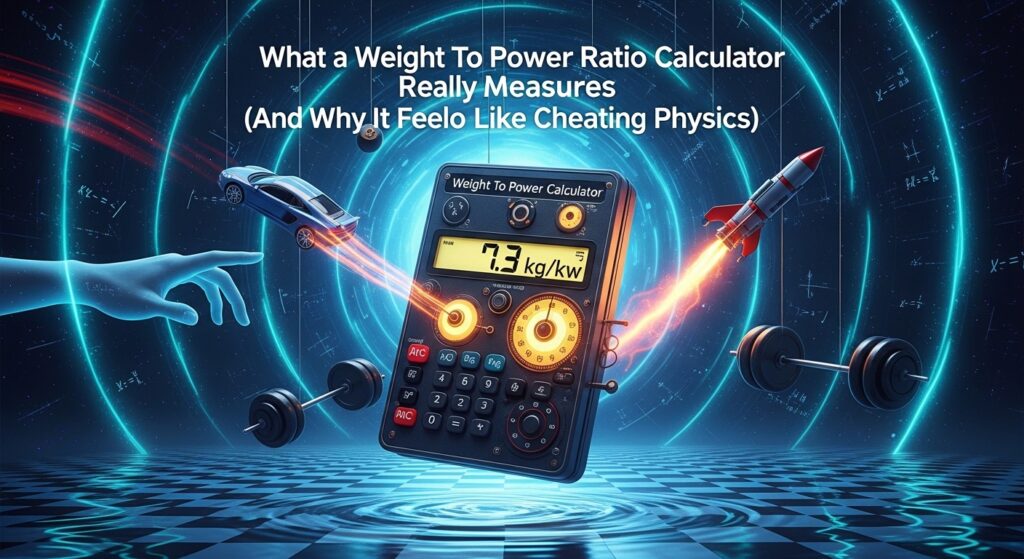
At its simplest and I say “simple” knowing full well physics students might roll their eyes it’s a division formula. Power ÷ Weight. That’s it. The core Power-to-weight formula is just a ratio calculation.
You take the engine power output maybe in Horsepower (HP / hp) or Kilowatt (kW) and divide it by the vehicle’s Curb weight, usually in Kilogram (kg) or Pound (lb / lbs).
But that tidy little division hides something electric.
Because power is about how fast work can be done. Weight well, mass really is about how much stuff you’re asking to move. And in the land of Newtonian mechanics, force and acceleration are close friends.
The lighter the mass for a given force, the quicker the acceleration. That’s not just theory. That’s the physics of acceleration breathing down your neck.
Think about a Ford Fiesta versus a Ford F-Series pickup truck. The truck might have more raw engine power output, sure. But it’s also hauling more tons sometimes literally in Metric ton units.
When you run a proper power to weight ratio calculator, you sometimes get a surprise. The smaller car can leap off the line with more eagerness. Not always faster in top speed, but quicker in that immediate, neck-snapping way.
And then there’s the absurd end of the spectrum. A Koenigsegg Jesko Absolut with its Twin-turbocharged 5.0-liter V8 engine is engineered for a theoretical Top speed (330 mph mentioned).
Meanwhile, the Bugatti Chiron runs a Quad-turbocharged 8.0-liter W16 engine. Both are masterpieces of Carbon fiber construction and Aerodynamic engineering, designed to wrestle with the drag equation and tame aerodynamic drag like it’s a stubborn pet.
When you compare the Koenigsegg Jesko power to weight ratio to the Bugatti Chiron power to weight ratio, you’re not just comparing numbers. You’re comparing philosophies of motion.
Units, Conversions, and That Slightly Annoying Math We Secretly Love
Here’s where things get messy in a charming way.
Some people prefer hp/kg. Others want kW/kg. In the U.S., you’ll hear hp/lb tossed around like it’s common kitchen seasoning. In racing circles, hp/t (horsepower per ton) makes an appearance. Cyclists obsess over Watts per kilogram (W/kg). The units change, but the soul of the equation doesn’t.
A good automotive engineering calculator or vehicle performance comparison tool handles the chaos gracefully. It lets you convert hp to kW, or convert kg to lbs, using the right conversion factor behind the scenes.
A solid unit conversion calculator doesn’t make you think too hard; it just quietly performs dynamic unit conversion, offers independent unit selections, and triggers instant result recalculation like it’s showing off.
The best tools even allow multi-entry comparison. You input three cars. Or five. Maybe a Motorbike, a Pickup truck, a couple of Supercars, and why not a Dumper truck just for drama. The system highlights the highest ratio automatically. That auto-highlight feature feels like a tiny celebration.
And yes, the Division formula (Power ÷ Weight) remains untouched beneath the fancy dropdown unit selector and real-time updates. It’s old-school math dressed in modern UX.
From Formula 1 to Moon Buggies: Where Power-to-Weight Ratio Becomes Everything

If you want to see obsession in its purest form, look at a Formula 1 car. There are minimum weight limits in F1 regulations for a reason. Too light, and it’s unsafe. Too heavy, and you’re slower. The F1 power to weight ratio is engineered within razor-thin margins.
Racing performance isn’t just about peak output. It’s about performance optimization, weight reduction, and dancing around rolling resistance and tire friction without stepping on the toes of physics.
Now shift your gaze upward. Spaceships operate under different gravitational conditions. On Earth, you deal with Earth gravity. On the Moon where a Moon buggy once bounced along under Moon gravity (1/6 Earth gravity) weight behaves differently.
The mass vs weight distinction suddenly matters a lot. Mass remains constant. Weight changes with gravity. So the Power to Mass Ratio becomes a more universal metric across planets.
Even Trains and Ships care about this, though in different ways. They battle rolling resistance coefficient values and hydrodynamic drag rather than chasing extreme acceleration. But the principle is steady: more power per unit mass means more potential for movement.
It’s kind of poetic, isn’t it? The same ratio that defines a hypercar’s violent launch also whispers in the background of a cargo ship easing out of harbor.
The Weight To Power Ratio Calculator in the Real World of Daily Drivers
Let’s bring it down from 330 mph fantasies.
Most of us aren’t piloting a Hypercar to work. We’re in something practical. Maybe a hatchback. Maybe a family SUV. When you use a power to weight ratio calculator for everyday vehicles, you start understanding why some cars feel “peppy” while others feel… well, like they need coffee.
A lighter vehicle with moderate horsepower can outperform a heavier one with slightly higher peak output. That’s the secret sauce behind many “lightweight car performance” legends. Lightweight materials aluminum, composites, carbon fiber aren’t just marketing fluff. They shift the ratio.
But here’s the thing people forget: the ratio is an acceleration performance metric, not the whole story. Top speed depends on aerodynamic drag and engine gearing.
Rolling resistance, tire friction, and drivetrain losses nibble away at theoretical perfection. That’s why the car power to weight ratio formula is a starting point, not a prophecy.
Still, when you’re comparing best power-to-weight ratio cars, it’s an incredibly revealing number. It strips away marketing gloss and asks a blunt question: How much muscle is pushing how much mass?
Cycling, Athletes, and the Human Engine

This isn’t just for machines.
In cycling, the Cycling power-to-weight ratio is everything on a climb. A Power meter measures Cycling wattage, and riders obsessively calculate Watts per kilogram (W/kg). A lighter rider producing the same wattage as a heavier one will usually ascend faster. Gravity is an uncompromising referee.
A Cycling wattage calculator paired with accurate Body weight measurement becomes a personal performance benchmarking tool. Athletes compare ratios, not just raw watts. It’s the same logic as comparing engine output comparison in cars, but the engine is made of lungs and stubbornness.
And there’s something beautifully humbling about that. Whether you’re a machine made of steel or a human made of grit, the math doesn’t care.
How to Calculate PWR Without Overthinking It
If you’re wondering how to calculate PWR, here’s the straightforward way:
Take engine power output (say, 300 hp).
Divide by vehicle weight (say, 1,500 kg).
That gives you 0.2 hp/kg.
Or, if you prefer:
Convert horsepower to kilowatts.
Convert kilograms to pounds.
Express the result per 1,000 units or as ratio per single unit.
Modern tools handle automatic recalculation. They even show benchmark comparison results. Some highlight the highest ratio in bold like it’s awarding a trophy.
If you’re building your own sheet or tool, remember the mass-to-power analysis is only as accurate as your inputs. Use curb weight, not dry weight (unless you’re comparing racing specs). Be consistent with units. And always double-check your conversion factor.
It’s basic math, yeah. But when you see the numbers line up in a clean column, you start spotting patterns. Trends. Surprises.
Beyond Cars: Motorbikes, Dumper Trucks, and Grand Touring Comfort
A Motorbike often has an astonishing horsepower per kilogram figure. That’s why even modest bikes feel ferocious. Meanwhile, a Dumper truck may have enormous power in absolute terms but a modest ratio due to its sheer tons of mass.
Grand touring comfort vehicles balance power and weight differently. They may sacrifice the absolute best ratio in favor of stability, luxury, and quietness. Performance tuning metric decisions always involve trade-offs.
And then there’s the odd joy of comparing absurdly different machines. A Pickup truck versus a Hypercar. A racing car power ratio versus a freight train’s steady pull. It’s not always fair but it’s always interesting.
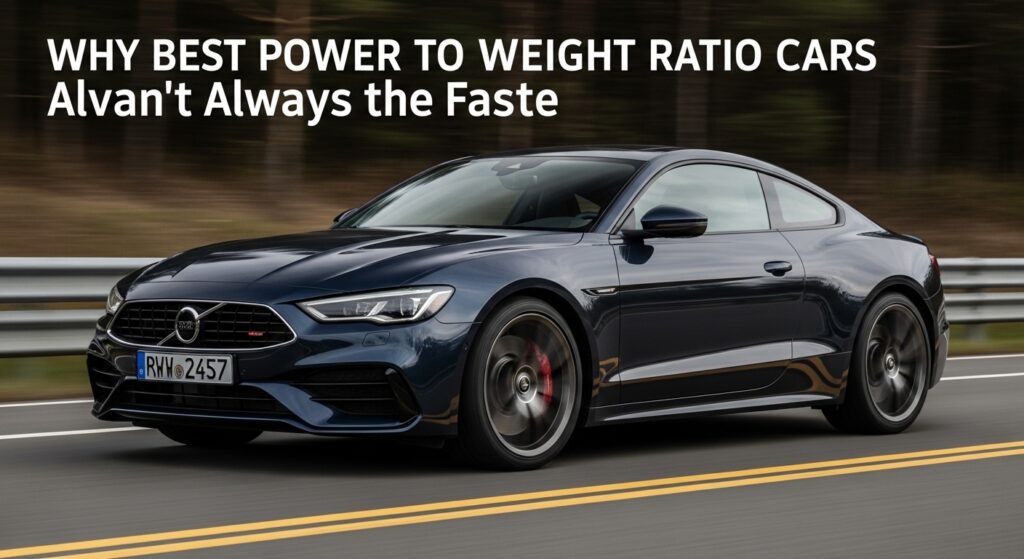
Why the Best Power to Weight Ratio Cars Aren’t Always the Fastest
Here’s a slightly rebellious truth.
The best power to weight ratio cars on paper don’t automatically win every race. Aerodynamic drag rises with speed. The drag equation doesn’t care how impressive your hp/kg looks at zero mph. Rolling resistance creeps in. Tire friction limits how much of that power can actually reach the ground.
So while a stellar ratio predicts strong acceleration, vehicle speed potential at the high end depends on many other variables. Theoretical top speed is a collaboration between power, drag, gearing, and stability.
That’s why the vehicle performance comparison conversation should always include context. Street driving? Track use? Mountain roads? Highway pulls?
The ratio is a flashlight, not the entire map.
Building or Choosing the Right Vehicle Performance Comparison Tool
If you’re designing or selecting a vehicle performance comparison tool, look for:
- A dropdown unit selector for flexible inputs
- Real-time updates with smooth fade-out animation
- Independent unit selections for power and weight
- Multi-entry comparison capability
- Dynamic labels for clarity
- Automatic recalculation on input change
- Clear highlighting of the highest ratio
It should feel effortless. Instant calculation. No mental gymnastics. Just input, observe, compare.
When tools respect the user’s time, they make complex ideas feel approachable. And honestly, that’s what good engineering communication should do translate without dumbing down.
Frequently Asked Questions
Power to Weight Calculator
A power to weight calculator helps you determine how much power a vehicle produces relative to its weight by dividing total horsepower (or kW) by total mass. It’s commonly used to compare vehicle performance and predict acceleration potential.
bhp per tonne Calculator
A bhp per tonne calculator measures how many brake horsepower units a vehicle produces for every metric ton of weight. This metric is especially popular in the UK and motorsports for evaluating real-world performance.
Power to Weight Ratio Calculator
A power to weight ratio calculator quickly computes the ratio between engine output and vehicle mass, typically shown in hp/kg, kW/kg, or hp/lb. A higher ratio generally indicates faster acceleration and better overall performance.
Read this Blog: https://wittyeche.com/graduation-cap-size/
A Quiet Reflection on Power, Weight, and What It All Means
There’s something metaphorical about the Power-to-Weight Ratio (PWR). In machines, it defines acceleration. In life, it feels like a reminder. How much strength are we carrying relative to our burdens?
A lighter load with steady power moves gracefully. Excess weight, even with great strength, can slow progress. It’s not a perfect analogy don’t overthink it but it lingers.
Whether you’re analyzing a Koenigsegg Jesko Absolut, tuning a Motorbike, optimizing a Formula 1 car, or calculating your own cycling watts per kg before a big climb, the ratio teaches a simple lesson: efficiency matters.