

There’s something oddly human about comparing things. We compare our height to our siblings, this year’s Grade Point Average (GPA) to last year’s, the Sales price of a jacket to its Discounted price, even the Height of the Washington Monument to the Statue of Liberty when we’re feeling randomly curious on a Tuesday afternoon. Comparison is how we make sense of the world.
And tucked inside that everyday comparing habit is a quiet little math tool called Percent Difference. It sounds stiff, almost bureaucratic, but it’s not.
It’s actually one of the most practical ways to understand the magnitude of difference between two values without getting tangled in who started first or who ended last.
So if you’ve ever wondered how to calculate percent difference without your brain doing a small dramatic sigh, you’re in the right place. Let’s walk through it slowly, honestly, and maybe even a little playfully.
📊 Percent Difference Quick Guide
| Topic | Explanation | Formula / Example |
|---|---|---|
| Percent Difference Definition | Measures the relative difference between two values using their average. | Compares values without labeling one as initial or final. |
| When to Use | When comparing two independent values (e.g., two prices, two speeds). | Price A vs Price B |
| Percent Difference Formula | Absolute difference divided by average, then × 100 | |a − b| / ((a + b) / 2) × 100 |
| Step 1 | Find absolute difference | |a − b| |
| Step 2 | Find average of values | (a + b) / 2 |
| Step 3 | Divide difference by average | Difference ÷ Average |
| Step 4 | Multiply by 100 | × 100 |
| Result | Express as percentage | Add % symbol |
| Example 1 | Compare 80 and 100 | |100 − 80| = 20 |
| Average = (100 + 80)/2 = 90 | 20 ÷ 90 × 100 = 22.22% | |
| Example 2 | Compare $50 and $60 | Difference = 10 |
| Average = 55 | 10 ÷ 55 × 100 = 18.18% | |
| Difference from Percent Change | Percent difference uses average as denominator | Percent change uses initial value |
| Percent Change Formula | (Final − Initial) ÷ Initial × 100 | Used for increase/decrease |
Percent Difference Definition (In Real Human Words)
The percent difference definition is simpler than it first appears.
Percent Difference measures the relative variation between two numbers by comparing their Absolute Difference to their Average of Values. It’s a relative measurement, meaning it tells you how far apart two numbers are compared to their typical size.
Unlike Percentage Change, it doesn’t care which number came first. There’s no emotional favoritism toward an Initial Value or a Final Value. It just says, “Here are two values. How different are they, really?”
Mathematically speaking, it uses:
- The Difference Between Two Values
- The Absolute Value
- The Mean (Average)
- A bit of Division
- A splash of Multiplication
- And finally, the Percentage Symbol (%)
That’s the skeleton of the formula for percentage difference, but we’ll put some muscles on it soon.
The Percent Difference Formula (Symbolic and Plain English)
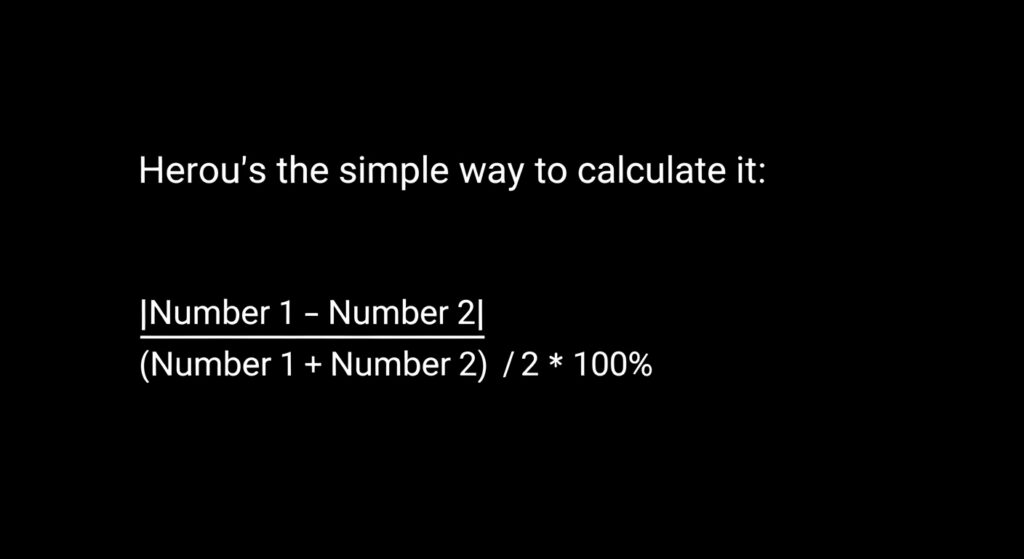
Here’s the formal Percent Difference Formula.
Percent Difference Formula (Symbolic Representation)
|a − b| / ((a + b) / 2) × 100
You might also see it written as:
Absolute Difference / Average × 100
Let’s unpack it gently.
- The Numerator is the Absolute Value of the difference.
- The Denominator is the Average of Values.
- Then you multiply by 100.
- Then you Express result as percentage.
That’s it. No tricks hiding behind the curtain.
In plain English, the mathematical expression says:
Take how far apart the numbers are, ignore the sign, divide that by their average, and multiply by 100.
And boom, you’ve got your percentage comparison.
Step-by-Step Calculation (Without Panic)
Let’s slow it down into a step-by-step calculation, because rushing math usually makes it worse, not better.
Imagine Molly Molly scored 80 on a test and Joan Joan scored 92.
We want the Percent Difference.
First step: Find absolute difference
92 − 80 = 12
The Absolute Difference is 12.
Second step: Compute average
(92 + 80) / 2 = 86
That’s the Mean (Average).
Third step: Divide difference by average
12 ÷ 86 ≈ 0.1395
Fourth step: Multiply by 100
0.1395 × 100 = 13.95
Final step: Express result as percentage
13.95%
So the percent difference between Molly and Joan’s scores is about 13.95%.
Notice how we never labeled one as the Initial Value or Final Value. That’s what makes this different from Percentage Change.
Percent Difference Examples from Real Life
Math feels less intimidating when it smells like real life, so let’s look at different scenarios.
Example: Speed Comparison
Nick Nick runs at 18 Kilometers per hour (km/hr) and Zoey Zoey runs at 15 km/hr.
Absolute Difference = 3
Average = (18 + 15) / 2 = 16.5
3 ÷ 16.5 ≈ 0.1818
× 100 = 18.18%
So their running Speed differs by about 18.18%.
That’s a quantitative comparison of athletic performance without saying who improved or declined.
Example: Cost Comparison
John John bought a phone for 600 Dollars ($).
Noah Noah found it elsewhere for 660 Dollars ($).
Absolute Difference = 60
Average = (600 + 660) / 2 = 630
60 ÷ 630 ≈ 0.0952
× 100 = 9.52%
So the Cost difference is 9.52%.
That’s useful in data analysis, especially when comparing prices across stores.
Difference Between Percent Difference and Percent Change
This part confuses people, so let’s be very clear.
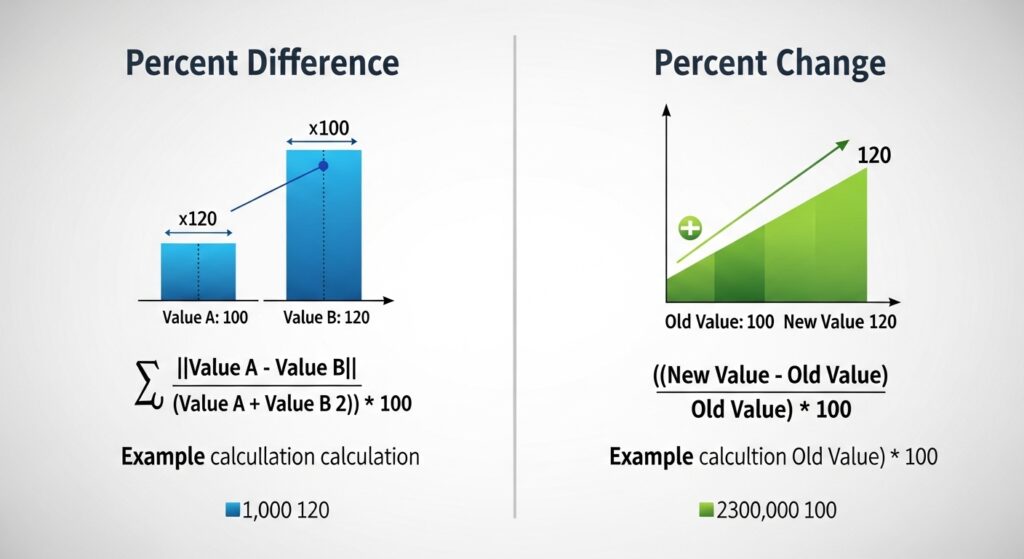
Percent Change measures increase or decrease from an Initial Value to a Final Value.
The Percentage Change Formula is:
(Final Value − Initial Value) / Initial Value × 100
This can produce a Positive value (for an Increase) or a Negative value (for a Decrease).
But Percent Difference:
- Uses Absolute Value
- Always produces a positive result
- Measures Relationship between values
- Doesn’t assume time order
So when someone asks about the difference between percent difference and percent change, remember:
- Percent Change measures Increase/Decrease
- Percent Difference measures Magnitude of difference
In short, it’s percent change vs percent difference, and they’re cousins, not twins.
Why Absolute Value Matters
The Absolute Value in math is sneaky-important here.
Without it, the Difference Between Two Values might be negative. But the Absolute Difference → always → Positive. That ensures the focus stays on size, not direction.
Because when comparing heights, test scores, or Feet (ft) of two buildings, you usually care about how far apart they are, not who’s “ahead.”
That’s the whole idea behind the relative difference formula.
Classroom Examples and Practice Math Problems
In classrooms, teachers often introduce this concept through Worksheets filled with Solved math problems.
For Young learners, the steps are usually broken down like this:
- Identify both values
- Apply the Percent Difference Formula
- Simplify the Equation
- Double-check the Calculation
Here’s a simple classroom-style example:
Two students raised money for a Fundraiser. One collected $250, the other $300.
Absolute Difference = 50
Average = 275
50 ÷ 275 ≈ 0.1818
× 100 = 18.18%
That’s the percent difference in funds raised.
This kind of exercise shows up in practice percentage questions and in almost every percent difference worksheet you’ll ever see.
Percent Difference Step by Step (Another Example)
Let’s do one more, because repetition builds confidence.
Two cars travel at 55 km/hr and 65 km/hr.
Step-by-step calculation:
- Find absolute difference → 10
- Compute average → 60
- Divide difference by average → 10 ÷ 60 = 0.1667
- Multiply by 100 → 16.67%
- Express result as percentage → 16.67%
That’s percent difference step by step, clean and unmessy.
Percent Difference in Comparative Statistics
In Comparative Statistics, percent difference helps researchers measure relative variation between datasets.
Suppose two labs measure the same chemical reaction result but get slightly different numbers. The Relative Percent Difference helps evaluate consistency.
It’s widely used in:
- Engineering
- Economics
- Physics experiments
- Market research
It’s especially helpful when doing calculating relative change without assuming chronological order.
That’s what makes it powerful in comparative analysis.
Read this blog: https://wittyeche.com/what-is-114-12/
Overtime Transition vs Static Comparison
Here’s a subtle but important nuance.
If you’re measuring an Overtime transition, like revenue from January to February, you probably want Percentage Change.
If you’re measuring two separate but related values, like two different store prices on the same day, use Percent Difference.
One measures direction.
One measures distance.
It’s like comparing siblings versus tracking your own growth over time. Slightly different vibes.
Common Mistakes in Math Percentage Problems
Even confident students trip over these:
- Forgetting to use the Absolute Value
- Dividing by one value instead of the Average in percent difference
- Mixing up the Denominator
- Confusing it with percent change calculation
A gentle reminder:
Percent Difference → divided by → Average
Percent Change → based on → Initial Value
Keep that sticky note in your brain.
Practical Uses in Everyday Life
You might use percent difference when comparing:
- Apartment rents
- Grocery store prices
- Height differences in Feet (ft)
- Fuel efficiency
- Two job offers
It’s quietly useful in decision-making, especially when doing side-by-side comparisons.
Even when evaluating two universities’ average tuition costs, the percent difference can clarify whether the gap is dramatic or barely noticeable.
Practice Percentage Questions for Confidence

If you want to strengthen your skills, try:
- Comparing 45 and 50
- Comparing $120 and $150
- Comparing 5 ft and 5.5 ft
Work through the Step-by-step calculation each time.
That repetition turns confusion into fluency.
And fluency makes math feel less like a threat and more like a tool.
Frequently Asked Questions
percent difference
Percent difference is a way to measure the relative difference between two numbers by comparing their absolute difference to their average. It shows how far apart two values are in percentage form.
percent difference formula
The percent difference formula is: |a − b| ÷ ((a + b) ÷ 2) × 100. It divides the absolute difference of two numbers by their average and multiplies the result by 100.
percent difference equation
The percent difference equation is written as |Value 1 − Value 2| / Average of the two values × 100%. It always produces a positive result because it uses absolute value.
what is the percentage difference between two numbers
The percentage difference between two numbers is the absolute difference divided by their average, then multiplied by 100. It tells you how much the two numbers differ relative to their size.
percent difference calculation
Percent difference calculation involves three steps: find the absolute difference, calculate the average of the two numbers, and divide the difference by the average before multiplying by 100.
Final Thoughts on How to Calculate Percent Difference
So now, when someone asks you how to calculate percent difference, you won’t freeze or stare at the ceiling dramatically.
You’ll remember:
- Find the Absolute Difference
- Find the Average of Values
- Divide
- Multiply by 100
- Add the Percentage Symbol (%)
You’ll know the Percent Difference Formula
You’ll understand the difference between percent difference and percent change
You’ll recognize when to use each
And maybe most importantly, you’ll see that this isn’t just a rigid Formula floating in a textbook. It’s a way of understanding comparisons whether it’s test scores, Cost, Speed, or something as grand as comparing monuments.