

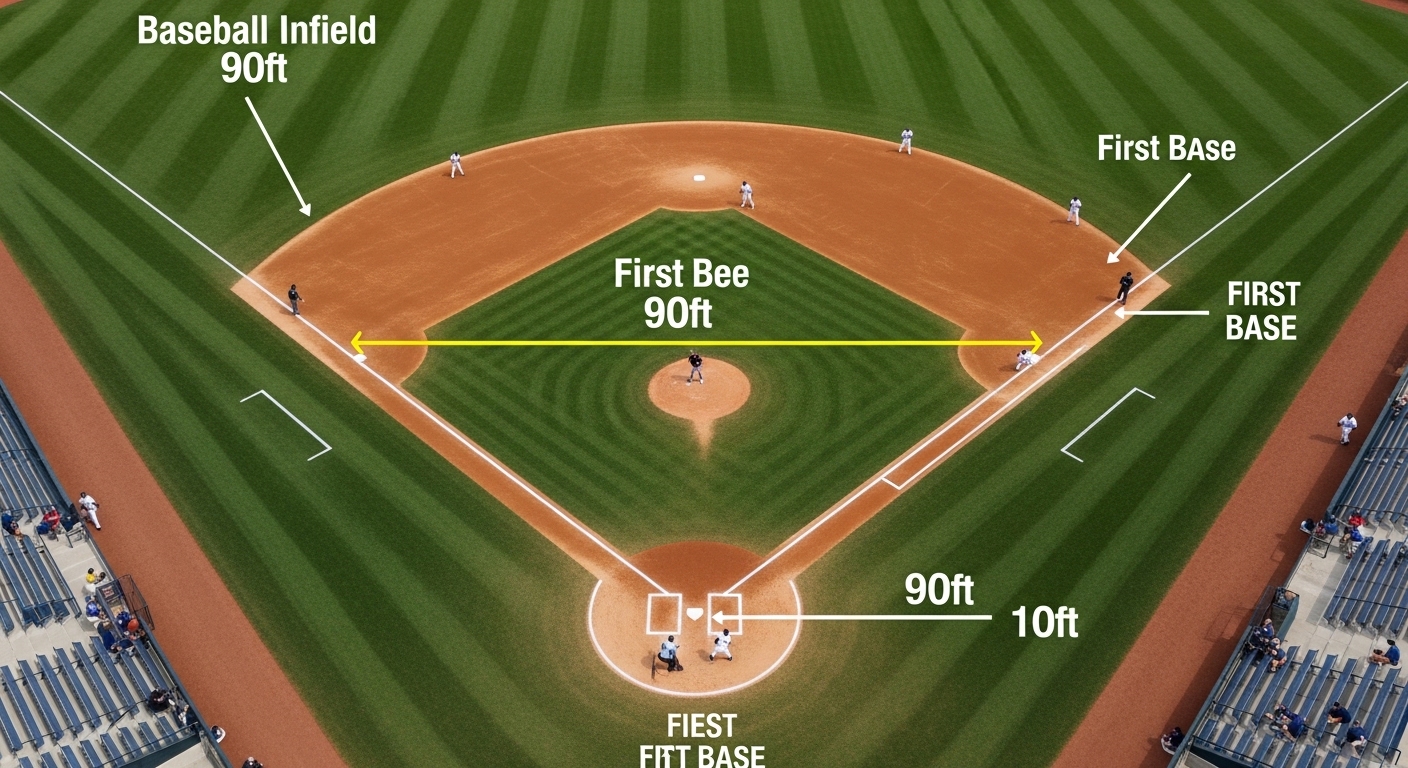
I remember once standing in an empty school parking lot at dusk, trying to explain to my niece just how far her paper airplane had flown. “About a hundred feet,” I said, and she squinted at the asphalt like it owed her money.
That’s the funny thing about distance it sounds simple, but it doesn’t feel simple. Especially when we’re talking about 100 feet (measurement unit), which is oddly both short and long depending on where you’re standing and what you’re comparing it to. It’s the kind of number that slips through your fingers unless you tie it to something real.
So let’s do that. Let’s make it real. Let’s stretch it out across courts and oceans and highways and city blocks, until you can almost see it humming in front of you.
How Long Is 100 Feet? (Quick Visualization Table)
| # | Example | Measurement | How It Compares to 100 Feet |
|---|---|---|---|
| 1 | Basketball court | 94 feet | 100 ft is slightly longer than the full court (baseline to baseline) |
| 2 | Blue whale | 80–100 feet | A large blue whale can be about 100 ft long |
| 3 | Sedan | ~15 feet | About 7 sedans lined bumper to bumper |
| 4 | School bus | ~35 feet | Nearly 3 school buses in a row |
| 5 | Semi-truck | 53 feet | Almost 2 semi-truck trailers |
| 6 | Boeing 737 | 100–130 feet | Around the length of a Boeing 737 |
| 7 | 10-story building | ~100 feet tall | About as tall as a 10-story building |
| 8 | Cricket pitch | 66 feet | 1.5 cricket pitches |
| 9 | Walking steps | 3–4 feet per step | Around 25–35 steps |
| 10 | Metric conversion | 30.48 meters | 100 feet = 30.48 meters |
How Long Is 100 Feet in Simple Conversion Terms?

Before we start lining up whales and buses like we’re hosting some strange parade, we should anchor ourselves in the numbers. Because yes, math can be cozy too.
- 100 feet in meters equals 30.48 meters. That’s your clean feet to meters conversion, the kind engineers mutter under their breath.
- 100 feet in inches is 1,200 inches. Which sounds dramatic, almost excessive, like inches are multiplying behind your back.
- 100 feet in yards equals 33.33 yards or roughly 33 yards if we’re being casual about it. That’s your classic yard to feet conversion moment.
If you’ve ever wondered, “What does 100 feet look like?” this is where the question starts to breathe. Because 30.48 meters sounds like a track field whisper. And 1,200 inches? That sounds like a measuring tape that just won’t quit.
This is where distance visualization becomes less about numbers and more about stories.
Sports Fields & Courts: 100 Feet Compared to Athletic Distances
Sports give us some of the best real-world measurement examples, because fields don’t lie. They’re painted with precision, and they’ve been measured more times than a tailor’s tape.
Consider a professional basketball court used in the National Basketball Association. The official Basketball court is 94 feet long from baseline to baseline.
That means 100 feet is actually longer than the entire court. When you imagine standing at one end and walking past the far hoop and then six more feet beyond? That’s the stretch we’re talking about.
It’s one of the clearest sports measurement comparison visuals you’ll get. The full court length in pro play often referred to when discussing pro basketball court dimensions doesn’t quite hit 100. So 100 feet feels bigger now, doesn’t it?
Now let’s shift to cricket. A Cricket pitch measures 22 yards, which equals 66 feet. So 100 feet would be one full pitch plus another 34 feet. That’s more than halfway to another bowler’s run-up. It reframes athletic field distance in a way that’s surprisingly tangible.
And if you’re thinking about a short sprint distance for youth training drills, 100 feet is about a third of a football field’s length. Not massive. Not tiny. Just enough to get your lungs politely annoyed.
How Long Is 100 Feet Visually in the Animal Kingdom?
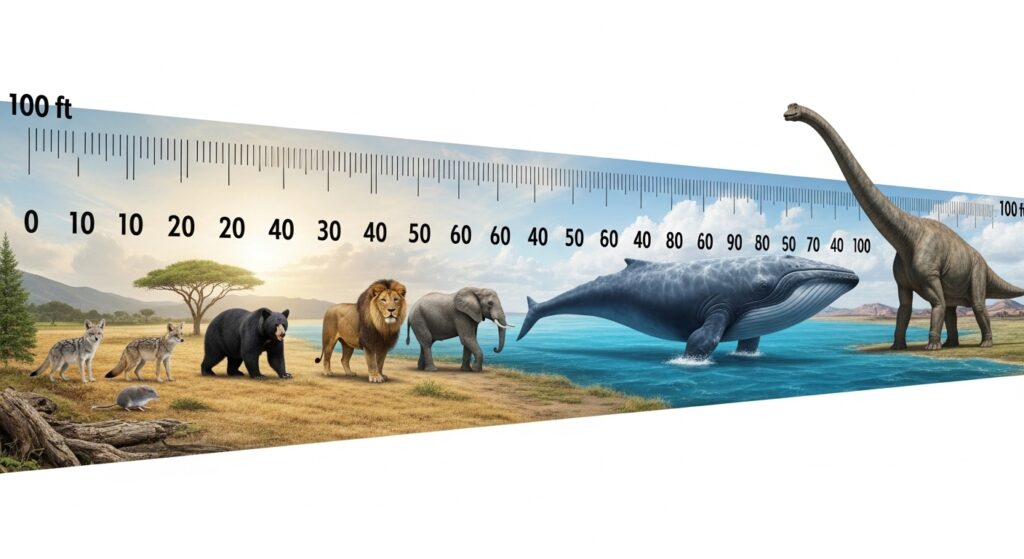
Let’s go bigger. Ocean big.
The Blue whale the undisputed largest animal on Earth can reach lengths of around 80 to 100 feet. So when you ask, “What is 100 feet long?” one honest answer is: an entire ocean giant. A breathing, singing, drifting cathedral of muscle and saltwater memory.
Imagine standing next to an ocean creature size like that. A full-grown whale length stretching the entire span we’re discussing. That’s your marine life scale comparison. That’s 100 feet with a heartbeat.
And in aquariums though no aquarium can truly hold one diagrams often show whale length against silhouettes of buses and submarines. It’s humbling, in a way that makes your shoulders drop.
When people search for “100-foot animal” or “giant sea animal dimensions,” they’re usually not expecting to bump into something this majestic. But here we are.
Vehicles Lined Up: Traffic Jam Length in Feet
Let’s bring it back to land, to something more everyday. Cars. Traffic. That one red light that never turns green fast enough.
The average Sedan is about 15 feet long. So if you line up cars bumper to bumper, you’d need about seven sedans to reach 100 feet. That’s a modest traffic lineup, the kind you see outside a school parking lot at 3 p.m.
Now picture a School bus, typically around 35 feet. Three of those in a row would be 105 feet. Just slightly over. That’s your bus dimensions comparison, and suddenly 100 feet feels like a convoy.
A standard Semi-truck trailer runs about 53 feet long. So two truck trailers nose to tail would stretch past 100 feet. That’s serious highway freight trucks energy, the kind that dominates an airport tarmac or long stretch of interstate.
And for a twist, the Boeing 737 measures roughly 100 to 130 feet depending on the model. That means when you board one, you’re walking into a machine that is, give or take, 100 feet long. That’s your aircraft length comparison, your passenger aircraft dimensions moment.
So the next time you’re estimating vehicle spacing estimation in a construction planning space, remember: seven cars, three buses, two semi-trucks, or one mid-sized jet.
How Tall Is 100 Feet? Buildings & Vertical Imagination
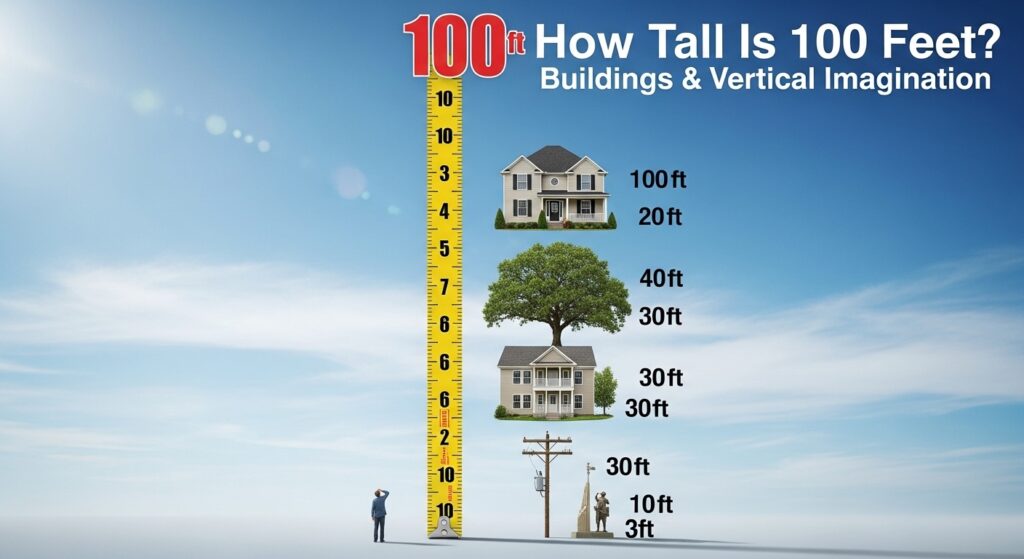
Height changes everything. When you flip 100 feet upright, it becomes a different kind of impressive.
A typical 10-story building stands around 100 feet tall, depending on floor-to-floor height. So if you’ve ever looked up at an apartment block and felt small, that’s roughly the vertical equivalent.
In many cities, a modest Apartment building or Office block hits somewhere near that mark. Not quite a Skyscraper, but tall enough to cast a serious afternoon shadow.
And consider telephone poles. Standard utility poles range from 40 to 50 feet. So stack two of them in your mind, end to end, and you’re hovering near 100 feet. That’s your pole height comparison, your quiet architectural measurement trick.
When people search “How tall is 100 feet building?” they’re usually picturing something grand. But sometimes it’s just the building down the street. Familiar, but now newly measured.
Walking It Out: Human Stride & Estimation Tricks
If you’re ever stuck without a measuring tape which happens more often than you’d think your body becomes the ruler.
The average human stride is about 3 to 4 feet. So it takes roughly 25 to 35 steps to walk 100 feet. That’s your steps to feet conversion, your built-in distance estimation technique.
I once measured out a party space this way, pacing across a backyard and whisper-counting under my breath like a mildly suspicious pirate. “Twenty-eight, twenty-nine…” It worked, mostly.
So if you’re wondering, “How far is 100 feet to walk?” it’s about half the length of a small parking lot. A short stroll. Not a hike. Enough to stretch your legs without breaking a sweat.
This is one of the simplest visual measurement tricks you can use in DIY distance calculation or construction space planning.
Everyday Spaces: Parking Lots, Lampposts & Familiar Gaps
In many urban areas, lampposts are spaced roughly 80 to 120 feet apart. So the distance from one lamppost to the next in a parking lot can approximate 100 feet. That’s a subtle urban scale reference most of us overlook.
In a school parking lot, 100 feet might stretch across two rows of parked cars plus the driving lane between them. It’s the kind of length you cross while waving awkwardly at another parent you sort-of know.
At outdoor events, knowing this span helps with party space measurement. A 100-foot string of lights, for example, can drape dramatically across a backyard wedding or community fair. It’s long enough to feel festive, not so long that it tangles into chaos.
And in the realm of trivia knowledge? It’s a crowd-pleaser. “Did you know a basketball court is shorter than 100 feet?” Watch eyebrows rise.
100 Feet Compared To: A Mental Cheat Sheet
If you need quick 100 ft measurement comparison references, here’s a memory-friendly bundle:
- Slightly longer than an NBA basketball court
- About the length of a blue whale
- Seven average sedans bumper to bumper
- Three standard school buses
- Two semi-truck trailers
- Roughly the height of a 10-story building
- Around 30.48 meters in metric terms
That’s your compact guide to objects 100 ft long and things that are 100 feet long in real life.
It’s not just about numbers. It’s about anchoring the abstract to the familiar.
Why Understanding 100 Feet Actually Matters
You might be thinking, this is neat and all, but when will I ever need to visualize 100 feet?
More often than you think.
In event planning, knowing the span of a venue. In home improvement, estimating fence lines. In sports training, gauging drill distances. In aviation curiosity while waiting at the gate. In marine documentaries, when the narrator whispers about an ocean giant’s length and you try to imagine it.
Accurate length comparison and unit conversion (feet to meters, inches, yards) aren’t just academic. They’re practical. They help us make decisions, avoid mistakes, and understand scale in a world that keeps building upward and outward.
How to Make Distance Visualization Personal
Here’s the real secret: tie it to your life.
If you live near a basketball court, walk its length and add six more steps. If you commute behind semi-trucks, picture two of them end to end. If you’ve ever stood beneath a 10-story building and tilted your head back until your neck protested, hold that image.
You can even create your own reference points:
- Count your steps across your living room and multiply.
- Measure your car length and do the math.
- Use a phone app for quick imperial to metric conversion when needed.
- Sketch it out in a notebook beside familiar objects.
And if you’ve got kids around, turn it into a game. Ask them how many of their bicycles it would take to reach 100 feet. Let them guess wildly. That’s how intuition grows.
Frequently Asked Questions
how long is 100 feet
100 feet is equal to 30.48 meters or about 33 yards. It’s roughly the length of a full professional basketball court or a blue whale.
how long is 100 ft
100 ft measures about 30 meters and can be visualized as 6–7 average cars lined up bumper to bumper. It’s a moderate distance you could walk in about 20–30 steps.
how tall is 100 feet
100 feet tall is about the height of a 10-story building. It’s also close to stacking two telephone poles end to end.
how long is 100ft
100ft is approximately 1,200 inches or 33 yards. In real life, it’s slightly shorter than a Boeing 737 airplane.
100 feet example
Examples of 100 feet include a professional basketball court, a blue whale, or two semi-trucks parked end to end.
Read this Blog: https://wittyeche.com/cups-is-16-fluid-ounces/”
A Final Thought on Scale & Wonder
There’s something quietly beautiful about understanding distance. About knowing that 100 feet is both a whale and a winged aircraft, both a building and a backyard stroll. It’s a reminder that scale is relative, that context shapes perception.
The next time someone asks, “How long is 100 feet visually?” you won’t just shrug. You’ll see courts and trucks and lampposts. You’ll feel the steps in your legs. You’ll picture an ocean giant gliding through dark blue water.
And maybe just maybe you’ll smile at how something so ordinary can stretch into something quietly extraordinary.
If you’ve got your own favorite way of visualizing 100 feet, share it. Is it a local landmark? A memory from sports practice? A childhood race across a field? Distance becomes meaningful when we attach it to experience.
And that, I guess, is the real measurement that matters.