

Some measurements feel… abstract. You read them on a blueprint, or on a product description, and your brain just nods politely without actually picturing anything. 20 feet, for example.
It sounds important, maybe even a bit dramatic, but if someone asked you right now, “Could you point out 20 feet measurement in front of you?” you might squint down the street and kinda guess.
I remember once helping a neighbor measure a backyard for a shed. He shouted, “Just leave about twenty feet from the fence!” and we both stood there doing the ancient human ritual of distance estimation which is basically educated guessing with confidence.
Eventually someone grabbed a measuring tape, and the mystery ended. But before that? We were doing pure length visualization, the same mental trick architects, contractors, and even urban planners quietly rely on every day.
So this article is a friendly guide to something oddly useful: how long is 20 feet in the real world. Because numbers like 240 inches, 6.1 meters, or 6.67 yards sound very scientific… but they don’t always feel real until you compare them to actual stuff around you.
Let’s explore some everyday objects, buildings, vehicles, and spaces that help you visualize 20 feet in real life without pulling out fancy tools like laser distance meters or total stations. Though those are cool, not gonna lie.
| # | Real-World Object / Reference | Approximate Length | How It Helps Visualize 20 Feet |
|---|---|---|---|
| 1 | Pickup Truck | 19–20 feet | A full-size pickup truck is almost exactly 20 feet long. |
| 2 | Standard Shipping Container | 20 feet | The common freight container used in global shipping measures 20 feet. |
| 3 | Delivery Truck | ~20 feet | Small city delivery trucks are usually close to this length. |
| 4 | Mobile Food Truck | 18–22 feet | Many street food trucks fall right around 20 feet. |
| 5 | Pontoon Boat | ~20 feet | A popular recreational pontoon boat size. |
| 6 | Giraffe | 18–20 feet tall | A full-grown giraffe’s height is roughly the same as 20 feet. |
| 7 | Tennis Court | 36 feet wide | 20 feet is a little over half the court’s width. |
| 8 | Extension Ladder | 20 feet | Common ladder length used for two-story homes. |
| 9 | Sedan | ~15 feet | A sedan plus about 5 feet equals 20 feet. |
| 10 | Two‑Story House | ~18–20 feet tall | Typical height to the roofline of many homes. |
| 11 | Residential Flagpole | ~20 feet | Many residential flagpoles stand around this height. |
| 12 | Park Bench | ~6 feet | About 3 park benches in a row equal ~20 feet. |
| 13 | Measuring Tape | 25 feet common | A standard tape measure easily measures 20 feet. |
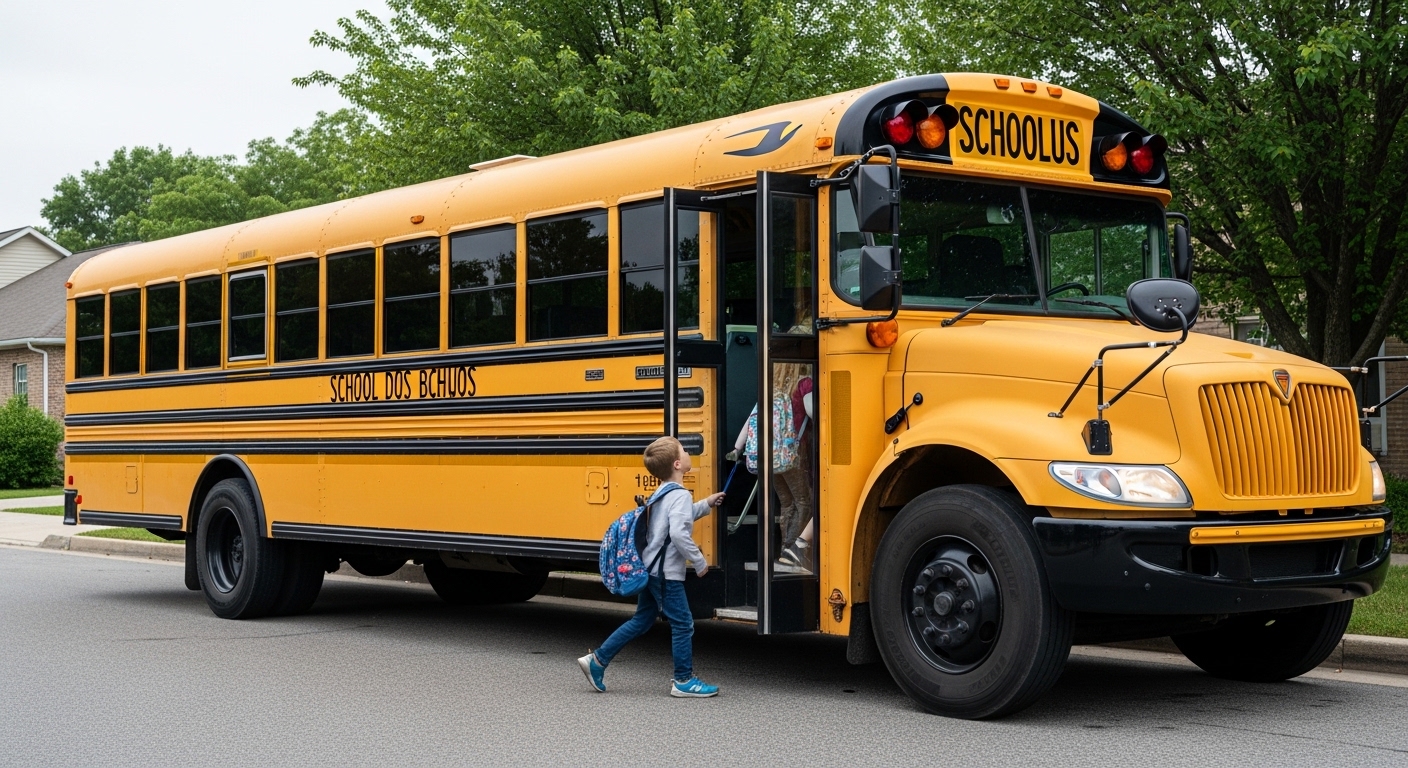
| 14 | School Bus | 35–45 feet | About half the length of a school bus. |
| 15 | Basketball Court | 94 feet long | 20 feet is about one-fifth of the court length. |
Understanding the Basic 20 Feet Measurement
Before jumping into comparisons, it helps to anchor the number itself.
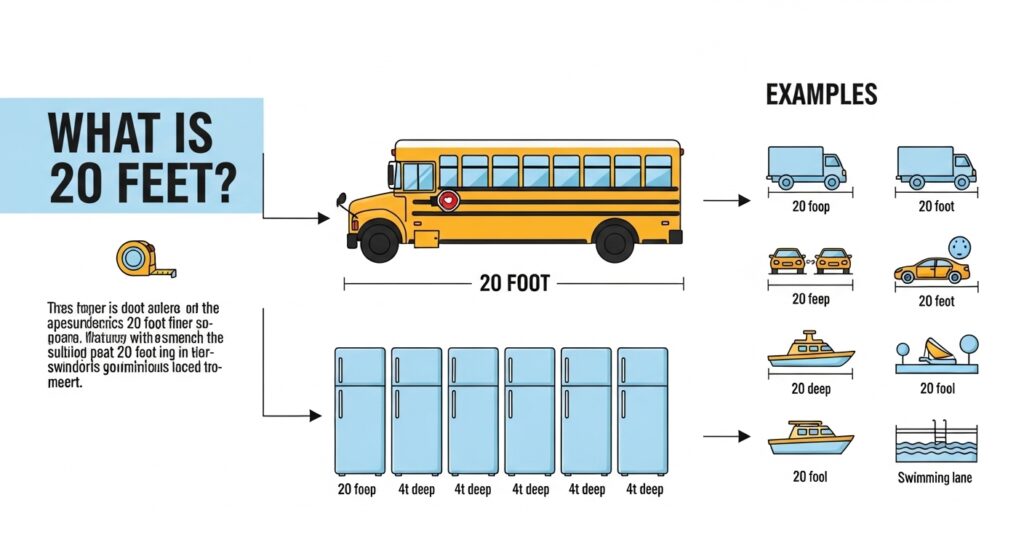
The 20 feet measurement equals:
- 240 inches
- 6.1 meters
- 6.67 yards
- Roughly 8 steps if each step averages about 2.5 feet (average step length)
Those step estimates are surprisingly useful when you’re doing quick distance estimation without measuring tools. Many construction professionals and landscape architects casually pace out distances on-site before final measurements happen.
From a spatial measurement perspective, 20 feet sits in a sweet middle zone. It’s longer than a room, shorter than most streets, and about the width of many residential features used in residential construction and landscape architecture.
But enough theory. Let’s look at some things that are 20 feet long or close enough to give your brain a reliable reference.
Transportation Objects That Help You Visualize 20 Feet
Vehicles are some of the easiest measurement reference objects, because we see them every single day. They provide surprisingly accurate real-world size comparison.
Pickup Trucks
A modern full-size pickup is often about 19–20 feet (pickup truck length).
Picture one parked in a driveway that’s basically 20 feet comparison in motion. If you walk from the front bumper to the tailgate, you’ve just covered almost exactly 240 inches.
For vehicle maneuverability calculations, traffic engineers and urban planners consider this length when designing parking lots and turning lanes.
Delivery Trucks
Small city delivery trucks used for parcel distribution are often right around the 20-foot range.
These vehicles appear constantly in urban logistics, and logistics planners use them as reference units when calculating cargo capacity, loading docks, and efficient logistics networks.
Mobile Food Trucks
A standard mobile food truck frequently measures around 18–22 feet.
This makes them a surprisingly perfect everyday example when asking “what is 20 feet?”. If you’ve stood in line for tacos beside one, congratulations you’ve already experienced a practical 20 feet comparison guide.
Pontoon Boats
Many recreational pontoon boats are built at exactly 20 feet long.
Marine designers like this length because it balances passenger capacity, stability, and docking convenience. In dock facilities, spacing calculations often assume boats of this general length.
Small Aircraft Wingspan
Some small training aircraft have wingspans close to 18–20 feet.
Aircraft designers work carefully with these standardized dimensions because hangars, taxiways, and storage areas must follow strict safety clearance requirements.
Suddenly 20 feet starts feeling less abstract, doesn’t it?
Infrastructure and Architecture: Everyday Structures Around 20 Feet
In the world of commercial building design and urban planning, 20 feet appears constantly. It’s a practical distance in structural elements, walkways, and design layouts.
Commercial Awnings
Large commercial awnings outside restaurants or shops often stretch about 20 feet across storefronts.
This width provides enough shade while fitting within common building codes used by architects and construction professionals.
Parking Space Rows
Two rows of parking spaces facing each other with a driving lane between them often create a span close to 18–20 feet in certain designs.
This dimension allows comfortable vehicle maneuvering space, something traffic engineers obsess over (and honestly… they should).
Residential Flagpoles
Many tall residential flagpoles stand about 20 feet high.
If you look at a flag fluttering above a suburban yard, you’re basically seeing a vertical version of 6.1 meters.
Commercial Storefront Widths
Small retail spaces sometimes measure about 20 feet wide across the front.
For urban planners, this creates consistent streetscapes while allowing efficient use of floor joists, roofline structure, and interior layout.
Two-Story Home Height
The average two-story house height often falls around 18–20 feet to the roofline.
So if you’re trying to imagine objects that measure 20 feet, simply look at the height of many suburban homes. That vertical space is nearly identical to the horizontal 20 feet measurement.
Recreation and Public Spaces That Measure About 20 Feet
Sports facilities and recreational areas rely heavily on measurement accuracy. Which makes them perfect practical 20-foot measurement references.
Tennis Court Perspective
A full tennis court width is 36 feet (tennis court width).
So 20 feet is just a little more than half the width of the court. If you stand near the center line and walk halfway across, you’re approaching that 20 feet comparison.
Indoor Swimming Pools
Some smaller residential or training indoor swimming pools measure around 20 feet across.
Recreational space design frequently uses this dimension for compact aquatic facilities.
Park Benches in Rows
A typical park bench is about 6 feet long.
Line up three of them end to end and you’re very close to 20 feet. Landscape architects often visualize walkway spacing this way.
Basketball Court Reference
A full basketball court length is 94 feet, and the 50 feet (basketball court width) creates a large playing surface.
Compared to that scale, 20 feet feels moderate roughly one-fifth of the court length. School transportation planners and sports facility designers often rely on these reference sizes.
Playground Rope Courses
Adventure playground rope bridges sometimes span around 20 feet between platforms.
Kids probably don’t think about spatial awareness, but their parents definitely do when watching them wobble across.
Animals and Nature: Surprisingly Tall Comparisons
Nature sometimes offers the most memorable size comparison for 20 feet.
Full-Grown Giraffe
A full-grown giraffe can reach around 18–20 feet tall.
Standing next to one (not recommended without zoo supervision) would give you an instant real-world examples of 20 feet moment.
And honestly… imagining a giraffe lying sideways is a funny way to picture how to visualize 20 feet in real life.
Tools and Equipment That Measure Around 20 Feet
Professionals dealing with construction measurements rely on certain tools that naturally fall near this length.
Extension Ladders
Many extension ladders extend to about 20 feet.
Roofing crews and contractors use them for accessing second stories, gutters, and roofline repairs.
Because of construction safety clearance standards, ladders must extend a few feet beyond roof edges another reason the extension ladder length is often near 20 feet.
Measuring Tape
Large measuring tape tools commonly come in 25-foot models.
Which means measuring 20 feet in inches (remember: 240 inches) is easily done with a single pull.
Laser Distance Meters
Modern laser distance meters allow builders to instantly measure distances like 20 feet without physical tape.
These tools are popular among architects, contractors, and construction professionals because they improve measurement accuracy dramatically.
Total Stations
Surveyors sometimes use total stations advanced measurement devices combining lasers, angles, and computers.
While they’re often used for much larger projects, even a simple 20 feet measurement on a construction site might be verified with one when precision matters.
More Everyday Objects That Are About 20 Feet Long
Let’s round out this guide with a few more everyday things that are 20 feet long.
Shipping Containers
A standard standard shipping container used worldwide in freight transport often measures 20 feet long.
This size is so common that it’s literally called a 20-foot shipping container, forming the backbone of modular transport systems used in global trade.
Logistics planners rely heavily on these containers because they fit perfectly onto ships, trucks, and trains.
School Bus Sections
A full school bus is longer than 20 feet, but a large section of its passenger compartment approximates that length.
That space houses rows of students, demonstrating how passenger capacity ties directly into dimensional planning.
Sedan Comparisons
A typical 15 feet (sedan length) is shorter than 20 feet, but if you add about five more feet in front imagine a sedan plus a small motorcycle — you’ve basically reached the 20 feet comparison mark.
Why Understanding 20 Feet Actually Matters
It might sound random, but spatial awareness around lengths like 20 feet matters in more situations than you’d think.
For example:
- Urban planners use it when designing sidewalks and public plazas
- Landscape architects consider it for garden layouts
- traffic engineers use it in road spacing calculations
- construction professionals apply it when measuring residential dimensions
- marine designers consider it when planning docking areas
Even homeowners planning patios, pergolas, or pools end up thinking in terms of standard objects that measure 20 feet.
The human brain understands space much better through real-world size comparison than raw numbers.
How to Measure or Estimate 20 Feet Without Tools
Sometimes you just need a quick estimate.
Try these tricks:
- Walk 8 steps (assuming 2.5 feet average step length)
- Visualize a pickup truck length
- Imagine a 20-foot shipping container
- Picture the height of a two-story home
- Line up three park benches
These mental shortcuts help with distance estimation without measuring tools, something builders and designers quietly practice all the time.
Frequently Asked Questions
How far is 20 feet visually
Visually, 20 feet is about the length of a small school bus or the height of a two-story house. It’s also close to lining up four standard park benches end-to-end.
How long is 20ft
20 feet equals 240 inches or about 6.1 meters in length. This distance is commonly used as a reference in construction, parking lane widths, and shipping containers.
How big is 20 feet
20 feet is considered a moderate length that fits many everyday structures like a small indoor pool width or a delivery truck. It’s large enough to span a room or small outdoor space comfortably.
20 feet visualized
To visualize 20 feet, imagine about eight average walking steps or the length of a standard shipping container section. It’s also close to the height of a full-grown giraffe.
20 feet example
Common examples of things around 20 feet include a shipping container, a pontoon boat, or a professional extension ladder. Many parking lot driving lanes are also designed to be about 20 feet wide.
Read this blog: https://wittyeche.com/how-long6-inches/
Final Thoughts: Turning Numbers Into Real-World Understanding
Numbers alone can feel… empty. But once you start attaching them to real objects trucks, houses, ladders, boats, even giraffes suddenly the concept clicks.
That’s the magic of length visualization.
The next time someone asks “how long is 20 feet?”, you won’t just say 240 inches or 6.1 meters. You’ll picture a pickup truck, a shipping container, or the height of a two-story home.
And if you ever find yourself standing in a backyard, estimating space for a shed like my neighbor did… well, you might smile slightly and think:
“Yep. That’s about twenty feet. Give or take a step.”
If you’ve ever used a clever trick for visualizing measurements, or if you know other objects that are 20 feet long, share them with others. Those tiny mental shortcuts make the world feel a bit more understandable and oddly more interesting too.