

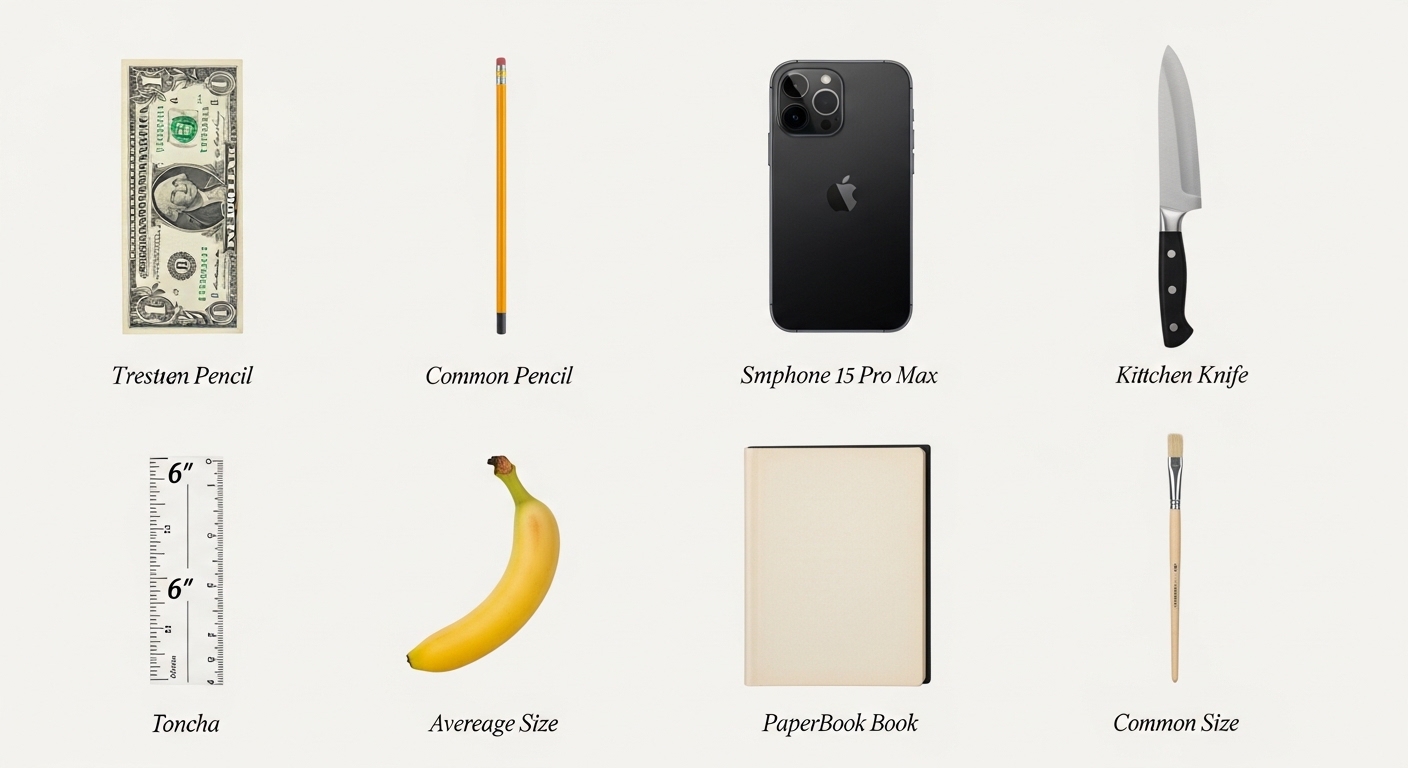
There’s this oddly specific moment in life maybe while wrapping a gift, cutting cake, or arguing gently with a tape measure that you pause and think, wait… how long is that actually? And somehow, the idea of Six inches floats in like a half-remembered song lyric. Not big, not tiny, just… there. Suspended between guesswork and confidence.
I remember my aunt once eyeballing ribbon for a newborn gift, insisting, “Oh this is about six inches,” and it turned out to be closer to a Foot. We laughed, but it kinda stuck with me how slippery measurement estimation can be. Our brains love shortcuts, but oh boy, they mess up sometimes.
In a world where rulers disappear right when you need them, knowing what does 6 inches look like in real life becomes weirdly useful. Whether you’re deep into DIY projects, slicing a sandwich, or packing a bag like a pro traveler, having a mental picture of this length helps more than you’d think.
So let’s wander through some everyday things that quietly whisper, “yeah, I’m about that long.” This isn’t just a list it’s a cozy little guide to sharpening your spatial awareness and laughing at your own size perception error along the way.
| Object | Approx. Length | Notes |
|---|---|---|
| Toothbrush | ~6 in (15.24 cm) | Common everyday size |
| Smartphone (e.g., iPhone 16 Pro) | ~6 in | Good visual reference |
| Pencil (used) | ~6 in | After sharpening down |
| U.S. dollar bill | ~6.14 in | Slightly longer than 6 inches |
| TV remote control | ~6 in | Varies by model |
| Subway 6-inch sub sandwich | 6 in | Classic food comparison |
| Kitchen knife (small) | ~6 in | Blade length, not full knife |
| Adult hand (palm to fingertip) | ~6–7 in | Depends on person |
Understanding Six Inches Through the Lens of Real Life
Before diving into objects, let’s anchor ourselves in some basics, just so we’re not floating off into wildly inaccurate guesses (which happens more than you’d admit, honestly).
Six inches in cm equals 15.24 centimeters (cm) which sounds more serious somehow, like it put on a lab coat. This is part of the Imperial system vs the Metric system conversation, where inches and centimeters politely disagree but still get along.
Half a foot, right? That’s another way to think about it. And if you’ve ever held a standard ruler comparison in your hands, you already know that six inches is right in the middle. Not dramatic, but very dependable.
Still, knowing numbers isn’t the same as feeling size. That’s where visual comparison steps in, like a helpful friend who says, “nah, just look at this instead.”
Everyday Objects That Quietly Measure Up
Let’s wander through familiar territory objects that you’ve held, dropped, or lost under the couch that double as a length reference.
The Surprisingly Reliable Six-Inch Crew
- A slightly worn toothbrush usually lands right around six inches, give or take a bit depending on how fancy your dental life is
- Many smartphone models hover near this length, especially something like the iPhone 16 Pro, which gives a solid phone screen size inches reference
- A standard pencil, once it’s been sharpened into existence a few times, ends up close to this magical number
- The iconic U.S. dollar bill is just a touch over six inches, making it a sneaky dollar bill trick for quick estimation
- A TV remote control, especially the slimmer ones, often fits neatly into the six-inch club
- A kitchen knife (not the dramatic chef kind, but the everyday one) can sit comfortably around this length
- A spoon, particularly the standard dinner one, often echoes this measurement in a quiet, unassuming way
- A credit card / ID card stacked about four times lengthwise gives you a clever card stacking method to visualize it
Funny thing is, you’ve probably handled all of these today and didn’t even notice their hidden measuring powers. That’s the charm of common objects for measurement they’re always there, just waiting to be noticed.
What Does Six Inches Look Like Using Your Own Hands?
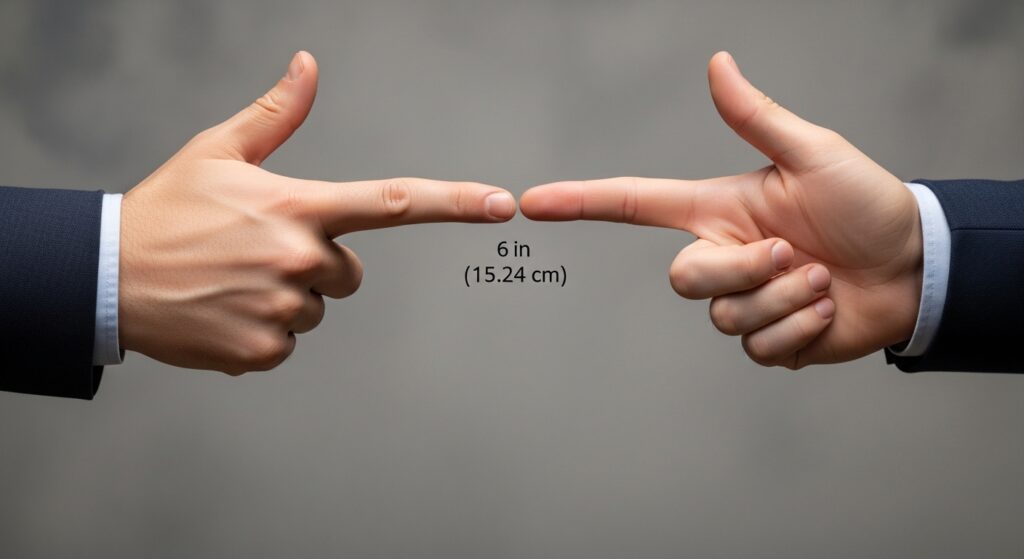
Now here’s where it gets personal, literally.
Your body is one of the best tools for estimating without ruler, even if it’s not perfectly precise. The average adult hand, from palm to fingertip, often hovers around six to seven inches. Not exact, but close enough for most everyday situations.
Handy (slightly imperfect) references
- The distance from your wrist to the tip of your middle finger is often near six inches
- A relaxed hand span (thumb to pinky) might stretch a bit beyond, but half of that span gives a decent approximation
- The palm to fingertip length works well when you’re in a rush and guessing boldly
But here’s the catch our brains love to exaggerate. That’s called overestimation bias, and it sneaks in like a mischievous gremlin. So while your hand is helpful, it’s not a sworn witness in court.
Six Inches in Food: A Delicious Perspective
Let’s be honest, food measurements stick better. There’s something about eating your references that just… clicks.
The edible rulers of the world
- A Sub sandwich (Subway) specifically the famous Subway 6 inch sub size is probably the most iconic example
- A neatly sliced piece of cake can often be cut to about six inches when you’re feeling generous
- A hotdog (depending on where you are) frequently lands near this length
- Some bread rolls or baguette portions echo that same size
- A chocolate bar broken into segments can approximate this with surprising accuracy
Food gives you a visceral sense of size. You’re not just seeing it you’re holding it, biting into it, experiencing it. That’s peak visual memory measurement, honestly.
Common Objects That Are 6 Inches Long in Creative Situations
Now let’s get a bit inventive, because real life doesn’t always hand you perfect examples on a silver platter.
When you need to improvise
- Folding a piece of printer paper in half lengthwise gives you a rough six-inch segment hello folding paper method
- Two stacked smartphone lengths (depending on model) can help you gauge slightly larger dimensions
- A screwdriver in a standard toolkit often aligns with this measurement
- Travel-sized items, like toiletry kits, frequently hover around this length perfect for measuring while traveling
- A compact notebook or planner can sometimes match this size
These moments are where quick measurement tricks shine. You don’t need perfection just a ballpark that keeps things moving.
The Psychology of Getting It Wrong (and Why That’s Fine)
Let’s not pretend we’re all measurement geniuses. Humans are gloriously inconsistent when it comes to dimension estimation.
There’s this fascinating thing called perception vs reality size, where what we think we see doesn’t match what’s actually there. You might swear something is six inches, only to find it’s eight… or four. It happens.
Common missteps we all make
- Overestimating small objects because they feel significant
- Underestimating larger objects because we compare them to bigger things
- Forgetting context six inches looks different on a table vs in your hand
- Relying too much on memory instead of present observation
These measurement inaccuracies aren’t failures they’re just reminders that our brains prioritize speed over precision. And honestly, that’s kinda beautiful.
Practical Ways to Use This Knowledge Daily
Now that you’ve got a feel for it, let’s make it useful. Because knowing how to estimate 6 inches without ruler isn’t just trivia it’s a life skill.
Everyday scenarios where this helps
- Aligning furniture spacing during a quick room rearrange
- Measuring ingredients or portions while cooking without tools
- Packing efficiently when traveling and space is tight
- Crafting projects where exact measurements aren’t critical
- Hanging frames or decorations with balanced spacing
These are the moments where household measurement hacks quietly save the day. No stress, no searching for tools just a bit of awareness and confidence.
A Slightly Philosophical Pause: Why Small Measurements Matter
Six inches isn’t just a number. It’s a reminder that small things hold meaning.
It’s the difference between a cramped shelf and a perfect fit. Between a crooked frame and a balanced wall. Between guessing wildly and knowing just enough.
There’s something comforting about having these little anchors in life tiny certainties in a world that often feels too big to measure.
How to Build Your Own Mental Measurement Toolkit
You don’t need to memorize everything. Just pick a few reliable references and stick with them.
Easy ways to get better at it
- Compare objects consciously during your day notice their lengths
- Use repetition to build visual comparison memory
- Keep one “anchor object” in mind, like your phone or a pencil
- Occasionally check yourself with a real ruler to recalibrate
- Practice in low-stakes situations, like arranging items on a desk
Over time, your spatial judgment skills sharpen without you even noticing. It’s like your brain quietly upgrades itself.
Frequently Asked Questions
is 6 inches long
Six inches is a medium-short length, about half a foot, commonly used for small everyday measurements. It’s roughly the size of many handheld objects.
things how big is 6 inches
Six inches is about the length of a standard postcard or a typical smartphone screen, making it easy to visualize using common items around you.
6 inch items
Common 6-inch items include a dollar bill, toothbrush, TV remote, and a 6-inch sub sandwich, all useful for quick size reference.
size how big is 6 inches
Six inches equals about 15.24 cm and is considered a practical length for small tools, gadgets, and everyday objects.
how big is six inches
Six inches is roughly the length of an adult hand from palm to fingertips or the long edge of a postcard, making it easy to estimate without a ruler.
read this Blog: https://wittyeche.com/how-longs-until-330-pm/
A Warm Ending (Because Every Guide Deserves One)
There’s something oddly satisfying about understanding something as simple as six inches. It’s not flashy knowledge, but it’s quietly powerful like knowing how to tie a perfect knot or fold a fitted sheet (okay maybe that one’s still hard).
The next time you wonder how long is 6 inches, you won’t need to guess wildly or squint suspiciously. You’ll just know, in that calm, grounded way that comes from experience.
And hey, if you’ve got your own quirky way of measuring maybe you use a snack, or your pet’s paw, or something wonderfully strange share it. These little human shortcuts are what make life feel real and shared.
Because in the end, it’s not just about inches or centimeters. It’s about noticing the world a bit more closely, and finding meaning in the small, measurable things we usually overlook.