


There’s a strange, quiet moment right before a graduation ceremony begins. The air hums with perfume and nerves and camera flashes, and someone somewhere is adjusting their Graduation cap in the reflection of a phone screen.
I remember tugging mine down, thinking it felt slightly too big and also somehow too small for the size of the day. It’s funny, we spend years earning a Diploma,
yet on that final morning we’re mostly concerned with whether our Square board (cap top) is sitting straight. Life’s like that, I guess monumental meaning resting on a neat, flat square of fabric and cardboard.
If you’ve ever wondered, what size is a standard graduation cap? or are all graduation caps the same size? you’re not alone. Beneath the pomp of Academic regalia and flowing Graduation gown, there’s actual math. Inches. Centimeters.
Head circumference measurements scribbled on order forms. And behind those numbers? A history stretching back to Medieval European universities, when Scholars and clergy first wore structured Academic headwear to signal learning and, maybe, a bit of authority too.
So let’s dive into it the measurements, the meaning, the structure, the symbolism and untangle the mystery of Graduation cap size and Graduation cap dimensions in a way that makes sense and maybe even feels a little magical.
Graduation Cap Size / Dimensions Chart
| Academic Level | Board Size | Cap Depth | Headband Size | Tassel Length | Notes |
|---|---|---|---|---|---|
| Elementary School | 8–9 inches (20–23 cm) square | 3–4 inches (7.6–10 cm) | 20–22 inches (51–56 cm) elastic | 9 inches (23 cm) | Smaller fit for children |
| Middle School | 8–9 inches (20–23 cm) square | 3–4 inches (7.6–10 cm) | 20–22 inches (51–56 cm) elastic | 9 inches (23 cm) | Youth sizing |
| High School | 9.4 inches (24 cm) square board | 3–4 inches (7.6–10 cm) | 22–25 inches (56–63.5 cm) elastic | 9 inches (23 cm) | Standard size |
| Undergraduate | 9.4 inches (24 cm) square board | 3–4 inches (7.6–10 cm) | 22–25 inches (56–63.5 cm) elastic | 9 inches (23 cm) | Most common size |
| Graduate (Master’s) | 9.4–10 inches (24–25.4 cm) square | 3–4 inches (7.6–10 cm) | 22–25 inches (56–63.5 cm) elastic | 9 inches (23 cm) | May vary by institution |
| Doctoral (Square) | 10 inches (25.4 cm) square | 3–4 inches (7.6–10 cm) | 22–25 inches (56–63.5 cm) elastic | 9 inches (23 cm) | Larger board |
| Doctoral (Tam) | 10–12 inches (25–30 cm) diameter | Soft crown style | Sized fit (not elastic) | 9 inches (23 cm) | Round tam design |
The Anatomy of a Graduation Cap: More Than Just a Flat Top
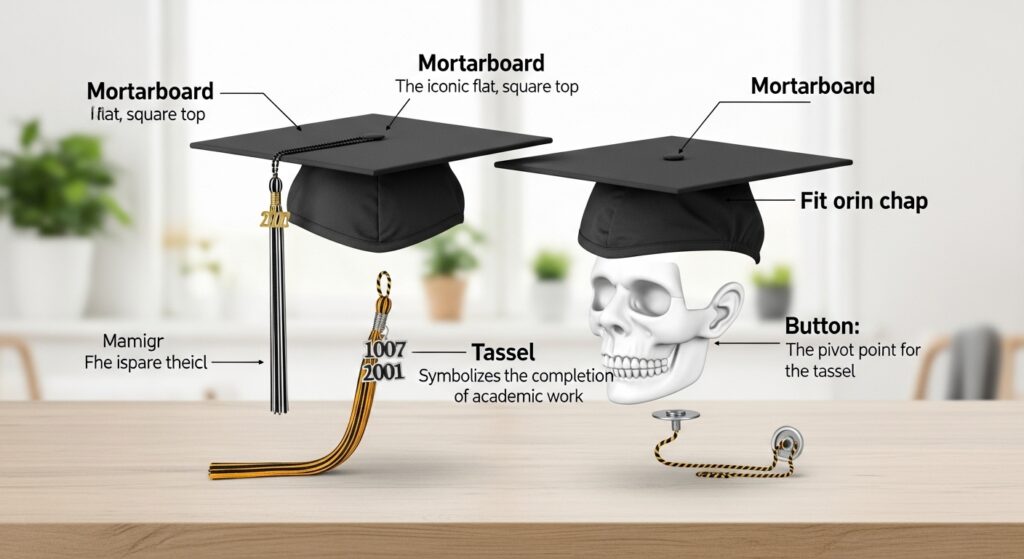
At first glance, the cap often called a Mortarboard looks deceptively simple. A square board balanced on a soft base, finished with a dangling Tassel. But the design is surprisingly precise. Not fussy, just… deliberate.
The standard American-style mortarboard typically features a 9.4 inches (24 cm) square board. That’s the classic measurement you’ll see in most Undergraduate graduation cap and High school graduation cap designs.
The board itself usually has a 0.25–0.5 inches thickness (0.6–1.3 cm) thin enough to look elegant, thick enough to keep its dignity when the wind picks up during the Cap toss ceremony.
Underneath the board, you’ll find a Plastic cap base reinforced with a Lightweight cardboard insert and wrapped in a Fabric covering that matches the gown.
The depth of the cap meaning how far it sits down on your head generally measures 3–4 inches depth (7.6–10 cm). This depth contributes to Cap stability, which sounds technical, but trust me, it matters when you’re walking across a stage in heels that maybe weren’t the best choice.
The Center button holds the tassel in place, and that tassel? It’s usually a 9-inch tassel (23 cm), long enough to swish with pride but not so long that it tangles in your eyelashes. There’s something oddly satisfying about its weight, like it knows the gravity of the moment.
Standard Graduation Cap Measurements: Breaking Down the Numbers
When people ask, How big is a graduation cap? they’re usually imagining the top board. But sizing isn’t just about the square it’s about fit, proportion, and head circumference too.
Most caps use a 22–25 inches elastic headband (56–63.5 cm), designed as a One-size-fits-most graduation cap solution. The Elastic fit system allows flexibility, accommodating most adult head sizes without needing custom tailoring. It’s a quiet marvel of Cap construction, really. You slip it on and it adjusts like it’s been waiting just for you.
For children, the measurements scale down slightly. An Elementary school graduation cap or Middle school graduation cap often features boards measuring 8–9 inches (20–23 cm) (children’s caps). Smaller heads, smaller squares, same big pride.
Doctoral caps are another story. A Doctoral graduation cap may measure 10 inches (25.4 cm) (doctoral variations) for square designs, while tam-style caps more on those in a moment range from 10–12 inches (25–30 cm) diameter (tam-style caps). The subtle increase reflects the elevated Academic achievement and centuries of evolving Academic dress traditions.
If you’re storing your cap after the ceremony (and you should it’s history), a 10-inch storage box with 4–5 inches storage depth usually does the trick. Slide it in gently. Don’t crush the corners. Those Reinforced corners worked hard to keep their sharp lines for your photos.
Graduation Cap Size Across Academic Levels
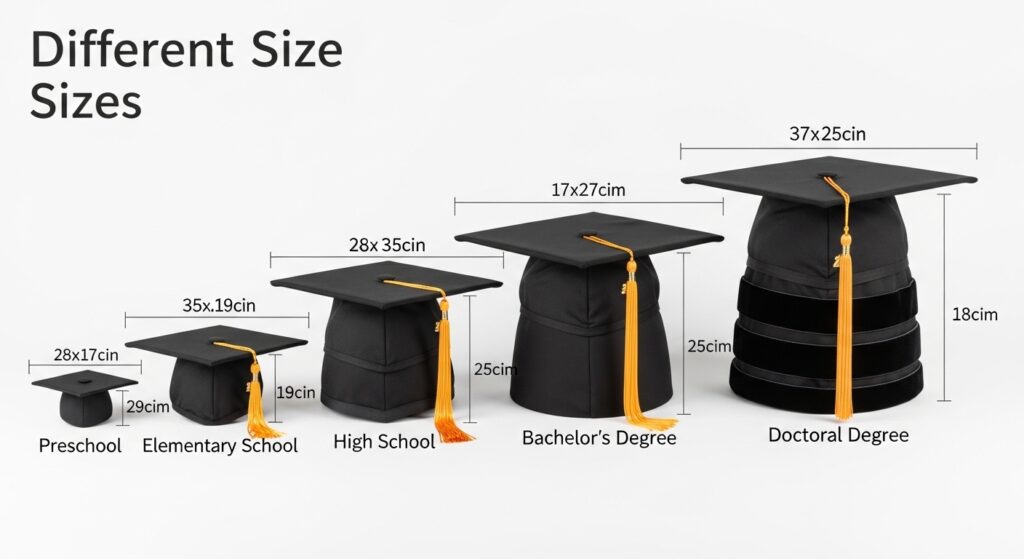
Not all caps are created equal, even if they look similar from the bleachers.
A High school graduation cap and Undergraduate graduation cap typically share the classic square design practical, symbolic, standardized thanks to 19th-century academic standardization movements that sought Visual unity in ceremony attire. This was when Standardized academic attire became more common, especially in American institutions.
A Graduate graduation cap often mirrors the undergraduate version but may feature different tassel colors to represent Academic disciplines or Academic honors. That tiny change in hue carries years of Scholarship and sweat.
Then there’s the Doctoral tam softer, rounder, distinguished. Unlike the square board, it resembles a structured beret, embodying prestige and authority.
It evolved partly from Continental European academic caps and traditions upheld in Catholic academic institutions. The tam’s circular form symbolizes continuity and advanced scholarship less rigid, more expansive. Honestly, it looks kinda regal.
British vs American Mortarboard Size: A Subtle Distinction
The British mortarboard typically adheres to similar square measurements, but the traditions differ slightly. In the UK, the cap may sit higher, paired with distinct gown shapes reflecting centuries of Academic tradition history rooted in Oxford and Cambridge.
In contrast, the American-style mortarboard became standardized in the late 1800s, prioritizing uniformity and mass production. The shift toward accessible higher education influenced design simplicity and practicality. It wasn’t just fashion it was about Equality and Institutional identity.
Elsewhere, in Asian academic institutions, variations may include adaptations of Western cap styles blended with local ceremonial dress. It’s a global conversation, stitched in black fabric.
How to Measure for a Graduation Cap (Without Losing Your Mind)
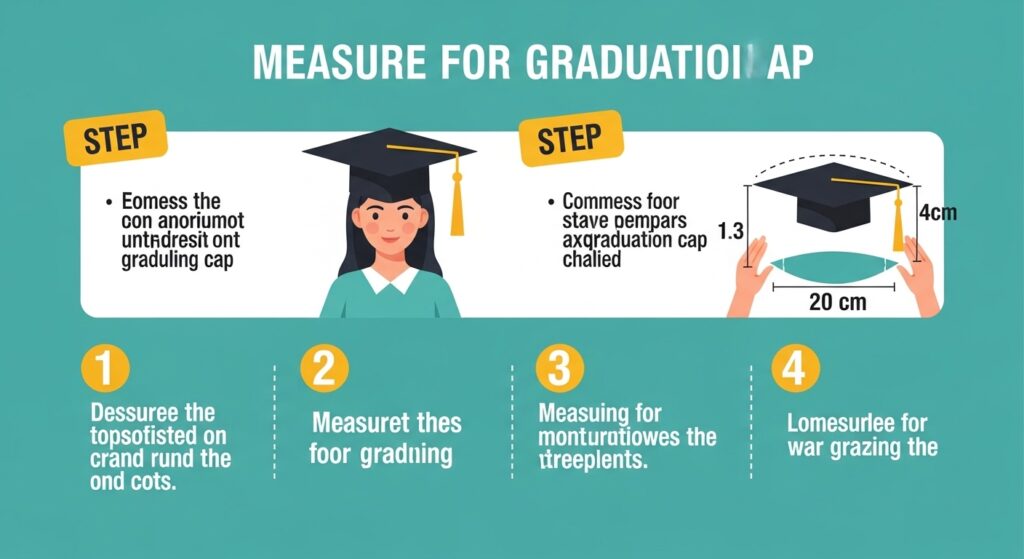
If you’re ordering a custom cap and wondering, How to measure for a graduation cap? breathe. It’s simpler than assembling IKEA furniture, promise.
Take a flexible tape measure and wrap it around your head, just above your ears and eyebrows. This is your Head circumference measurement.
Most adults fall within that 22–25 inch range, which aligns with standard elastic caps. If you’re outside that range, look for caps with an Adjustable circumference feature.
For DIY projects say you’re crafting a Handmade graduation cap dimensions design the typical board requires about 15 × 15 inches fabric (38 × 38 cm) to cover the square properly, allowing clean wrapping underneath. And remember Flat board alignment matters. A crooked square is… noticeable.
Graduation Cap Materials and Construction Secrets
The materials may seem modest, but they’re engineered for balance. The board’s thin profile ensures proper Weight distribution, especially important if you’re adding Cap decorations.
The base combines flexibility and firmness, maintaining Balance and stability atop various hairstyles curls, braids, straightened last-minute panic hair. The Cap board thickness prevents sagging, which is key if you’re planning a Personalized graduation cap masterpiece.
Storage is underrated too. Proper Graduation cap storage protects the symbolic integrity of your Academic headpiece. That cap isn’t just fabric it’s a wearable memory of your Educational milestone.
DIY Mortarboard Measurements & Decoration Without Tipping
Decorating a cap? Ah, this is where personality explodes.
When designing a DIY graduation cap, keep Height balance (2–3 inches max extension) in mind. Anything taller risks tilting your board. How to decorate a graduation cap without tipping comes down to smart Weight distribution and lightweight materials.
Try:
• 3D embellishments with foam instead of metal
• Subtle LED lighting decoration powered by tiny battery packs
• Quote-based cap art featuring lyrics or mantras
• A Photo collage cap design honoring family support
• Glitter borders with reinforced glue at the corners
• Minimalist gold leaf initials
• Cultural motifs reflecting heritage
• Tassel embellishments that match your field of study
Remember, the cap is a Knowledge foundation metaphor steady, balanced, centered. You don’t want it wobbling like a nervous thought.
Symbolism Behind the Square Academic Cap

The square shape isn’t random. It represents the mortarboard used by bricklayers symbolic of building knowledge brick by brick. The Square academic cap sits level, echoing ideals of fairness and equal opportunity in education.
The flat top design, sometimes called a Flat top graduation hat, suggests openness like a platform ready to support ideas. The ritual of moving the tassel from right to left during the Graduation ceremony marks transition. Before and after. Student and graduate.
That tiny motion carries centuries of Tradition, tracing back to Medieval European universities where headwear signified scholarly status. Over time, the evolution of the Mortarboard evolution reflected shifts in academic hierarchy and democratization.
Are All Graduation Caps the Same Size?
Short answer? Mostly, but not entirely.
Most institutions use standardized measurements for efficiency and visual cohesion. That’s why you’ll see similar boards across high schools and universities. However, distinctions appear in doctoral designs, children’s sizes, and international variations.
The Difference between undergraduate and doctoral caps lies primarily in shape and subtle dimension adjustments. Square versus tam. Structured versus soft. It mirrors the academic journey foundational learning leading to expansive research and thought leadership.
So yes, there’s uniformity but also nuance. Just like education itself.
The Emotional Weight of an Object Measured in Inches
It’s strange how something measured in centimeters can carry immeasurable meaning. A cap just under ten inches wide becomes a symbol of Prestige, perseverance, sleepless nights, borrowed textbooks, late coffee runs.
When you hold your cap before putting it on, there’s this flicker of realization I did it. The numbers fade. The measurements dissolve. What remains is the quiet thunder of accomplishment.
And when the caps fly into the air during the toss? That moment of suspended squares mid-air, spinning against the sky it’s like watching collective dreams levitate for a second before gravity calls them back down.
Read this blog: https://wittyeche.com/pokemon-card-sizes/
Frequently Asked Questions
graduation cap size top
The standard graduation cap top (mortarboard) measures approximately 9.4 inches (24 cm) on each side. It is designed as a flat square that sits parallel to the ground for a balanced and traditional look.
graduation cap square size
The graduation cap square size is typically 9.4 × 9.4 inches (24 × 24 cm) for high school and college graduates. Some doctoral caps may be slightly larger, reaching up to 10 inches (25.4 cm) per side.
how big is the circle on a graduation cap
Traditional mortarboards do not have a circle on top; they feature a square board. However, some doctoral caps use a round tam that measures about 10–12 inches (25–30 cm) in diameter.
dimensions of graduation cap
A standard graduation cap includes a 9.4-inch (24 cm) square top, a skull cap depth of 3–4 inches (7.6–10 cm), and a tassel about 9 inches (23 cm) long.
what are the dimensions of a graduation cap
Most graduation caps measure 9.4 inches (24 cm) square on top, with a thickness of about 0.25–0.5 inches (0.6–1.3 cm) and an adjustable head circumference for a secure fit.
Final Thoughts: Measuring More Than Fabric
So, what size is a standard graduation cap? Roughly 9.4 inches square for most, with elastic bands spanning 22–25 inches, tassels measuring 9 inches, and boards about half an inch thick. Doctoral versions expand slightly, children’s versions shrink gently.
But the real dimension of a cap isn’t listed on any sizing chart. It’s measured in courage, in persistence, in the steady accumulation of knowledge over time.
When you next see a row of graduates in full Cap and gown, remember: those neat squares aren’t just costume pieces. They’re architectural metaphors. Carefully balanced structures representing years of growth.
If you’re preparing for your own ceremony, take a moment to measure your head properly, store your cap safely, and decorate it thoughtfully.
Let your Custom graduation cap reflect who you are, without compromising its balance. And maybe just maybe keep it in that storage box afterward. Years from now, you’ll open it and feel the echo of applause.
If you’ve got a memory about your own graduation cap a windy mishap, a crooked tassel, a decoration disaster that somehow worked out I’d love to hear it. Because behind every precisely measured square board is a beautifully imperfect human story.