

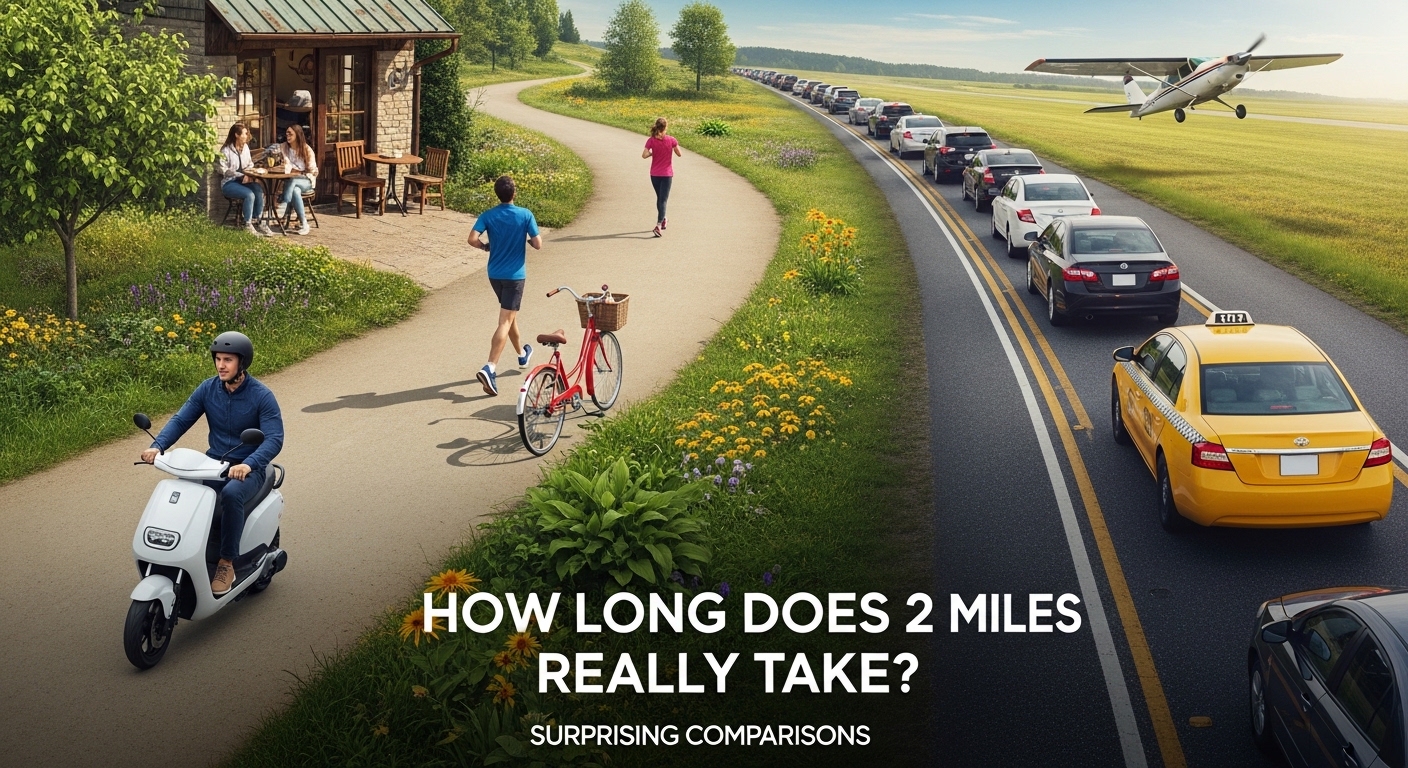
There’s something sneaky about 2 miles. It sounds short, like a shrug of a thing. Just a quick hop, right? But then you start walking it. Or driving it in thick traffic congestion.
Or running it on a humid morning when your legs are feeling like overcooked noodles. And suddenly, that neat little slice of distance measurement stretches and bends and becomes a story.
I used to think two miles was nothing. Then I tried jogging it after a winter of “I’ll start tomorrow.” That first mile felt polite. The second mile felt personal.
That’s when I realized we don’t really understand distance until we feel it in our lungs. So let’s actually look at it, turn it around in our hands, measure it, convert it, compare it, and see what it really means in real life not just on a map, but in minutes, sweat, and memory.
How Long Does 2 Miles Really Take? (Quick Comparison Table)
Here’s a short, straight-to-the-point table so you can instantly see what 2 miles really means in time and real-life comparisons.
| Activity / Scenario | Average Speed | Approximate Time | What It Feels Like |
|---|---|---|---|
| Highway driving | 60 mph (96 km/h) | ~2 minutes | Just a quick stretch of road |
| City driving | 20–30 mph (32–48 km/h) | 4–8 minutes | Depends on traffic lights & congestion |
| Walking | 3–4 mph | 30–40 minutes | A solid casual walk |
| Jogging | 6–8 mph | 15–20 minutes | Moderate cardio workout |
| Running (fast pace) | 9–10 mph | 12–14 minutes | Strong effort, controlled breathing |
| Cycling (steady) | 12–15 mph | 8–10 minutes | Light ride, not too intense |
| Swimming (Olympic pool) | Moderate pace | 30–40+ minutes | About 64 Olympic pool lengths |
| Track laps | Standard 400m track | ~8 laps | Common fitness benchmark |
| Football field laps | 120-yard field | ~10 laps | Repetitive but manageable |
| Soccer field laps | Full-size field | ~9 laps | Steady endurance walk/run |
The Raw Numbers Behind 2 Miles (And Why They Don’t Feel Real)
Before we lace up or start the engine, let’s ground this in numbers the kind that look tidy on paper but feel messy in motion.
Two miles equals:
- Feet (10,560 feet)
- Meters (3,218.7 meters)
- Kilometers (3.22 km)
- Exactly double 1,760 yards (1 mile)
That’s your basic unit conversion. Clean. Mathematical. Slightly boring if we’re honest. But numbers alone don’t answer the question: How long does 2 miles take?
Because time isn’t just math. It’s context. It’s speed (mph, km/h). It’s whether you’re stuck at traffic lights or cruising down interstate roads. It’s whether your shoelace comes undone. Again.
If you’re driving at 60 mph (96 km/h) under perfect highway driving conditions, two miles takes about two minutes. Blink-and-you’re-there quick.
At 30 mph (48 km/h), it’s roughly four minutes. At 20 mph (32 km/h) maybe through city centers with stop-and-go traffic now you’re looking at six minutes or more.
But that’s in ideal math-world. Real life has construction zones, unpredictable road conditions, pedestrian crossings, and the occasional driver who forgot what a turn signal is for. So your 2 mile drive time might stretch without warning.
Numbers are precise. Life is not.
How Long Does 2 Miles Really Take When You’re Walking?
Now we slow it down. Human pace. Foot to pavement.
The average adult walking at about 3 to 4 mph will cover a walking distance of two miles in roughly 30 to 40 minutes. That’s your typical 2 miles walking time.
But here’s the thing no spreadsheet tells you: walking two miles feels different depending on why you’re walking.
If you’re strolling through Central Park in Manhattan, passing Belvedere Castle and heading toward the Metropolitan Museum of Art, two miles slips by like a pleasant conversation. It doesn’t nag at you. It doesn’t ask much.
But if you’re walking two miles home because your car wouldn’t start? Different vibe entirely. Same distance in everyday terms, completely different emotional weight.
Two miles on a scenic path feels short. Two miles uphill with groceries feels… not short. That’s the strange elasticity of travel time.
How Long Does 2 Miles Really Take When You’re Running?

Now we bring in the lungs.
For runners, two miles is often a benchmark. A small but serious slice of endurance training. The average jogger might run it in 16 to 20 minutes. A faster athlete could dip under 12. Elite runners? Even faster, obviously, but we’re talking normal-human speeds here.
This is your typical 2 miles running time. Or your personal 2 mile workout distance if you’re building stamina.
On a standard running track, which is 400 meters per lap, two miles equals about 8 laps (track). That’s a manageable number. You can count it down. Four laps to go. Three. Two. One. Done.
If you’re sprinting think 100m dash intensity you won’t sustain that for two miles unless you’re superhuman. A Sprint is explosive. Two miles is sustained Endurance. It’s about Pacing, breath control, rhythm. That steady drumbeat of effort.
In track and field, the two-mile run has long been a fitness benchmark. Coaches use it to measure athletic performance, stamina, grit. It’s long enough to hurt. Short enough to survive.
And survival counts for something.
How Long Does 2 Miles Really Take in a Car?
Let’s get practical.
If you’re in the suburbs with light suburban driving, obeying speed limits, your average driving speed for 2 miles might sit around 35 mph. That’s about three to four minutes.
But in heavy urban driving with dense traffic congestion and frequent traffic lights, two miles might take 8 to 12 minutes. Sometimes more. Especially during rush hour when the world feels like it’s collectively late.
And don’t forget weather conditions. Rain stretches time. Snow multiplies it. Fog makes even short trips feel epic.
On long bridges like the Sunshine Skyway Bridge near Tampa in the United States, which spans 4.14 miles (bridge length), two miles doesn’t even get you across the whole thing. You’re still suspended over water, still committed.
That’s what’s funny about real-life distance comparisons. Two miles can be a commute, a workout, or half a bridge hanging above the bay.
Context keeps changing the answer.
What Does 2 Miles Look Like? Visualizing 2 Miles

Here’s where it gets interesting.
If you laid two miles out in a straight line across the National Mall, you could walk from the United States Capitol past the Washington Monument toward the Lincoln Memorial and still have distance left in your legs.
During the Presidential inauguration (January 20, 2009) of Barack Obama, massive crowds filled that space. People stood for hours.
The public gathering stretched across lawns that made two miles feel like shared history instead of geometry. It was a historic milestone, a collective breath in the cold air. Distance became memory.
That’s what I mean when I say visualizing 2 miles matters. We need anchors. Landmarks. Stories.
Two miles inside Central Park feels like an urban oasis. Two miles across open farmland feels endless. Two miles on a treadmill feels longer than both combined and I’m not entirely sure why, but you probably know what I mean.
2 Miles in Pools, Fields, and Stadiums
Let’s shift into structured environments the neat rectangles and ovals where we measure ourselves against lines and lanes.
In an Olympic swimming pool, which is 50 meters long, two miles equals roughly 64 Olympic pool lengths or 32 laps (pool comparison) if you’re counting down-and-back as a lap. That’s serious aquatic training. That’s shoulders-burning, goggles-fogging commitment.
In terms of Swimming laps, that’s not casual. That’s a workout circuit that asks something of you.
On a Soccer field measuring about 360 feet (soccer field length) by 225 feet (soccer field width) with a perimeter of 1,170 feet (soccer field perimeter), you’d circle it roughly 9–9.3 laps (soccer field) to hit two miles.
On an American football field 120 yards (football field length) long and 53.3 yards (football field width) wide with a perimeter of about 346 yards (football field perimeter), you’re looking at close to 10 laps (football field).
Suddenly two miles becomes repetitive. Lap after lap. Familiar scenery. That’s where Stamina gets tested, not by novelty, but by sameness.
And sameness is underrated as a teacher.
Parks, Pathways, and the Feeling of Space
Consider a park that stretches 2.5 miles (park length) that’s longer than our focus distance. Or a greenway marked as 4 km (park length metric). Those are walkable expanses where two miles feels like a meaningful chunk, but not overwhelming.
Two miles through a wooded trail with gentle elevation gain is different from two miles along a flat boardwalk. In one, your calves whisper complaints. In the other, your mind wanders.
That’s the beauty of measuring distance visually. It turns abstraction into experience.
When someone asks, How far is 2 miles, what they’re really asking is: can I do it? Is it manageable? Will it take forever?
The honest answer is: it depends on your efficient journey, your starting point, your mood, your shoes.
Predictable vs Unpredictable: The Time Variable
We love predictability. We crave knowing exactly how long something will take.
Under ideal conditions, two miles at 60 mph is two minutes. Walking at 3 mph is about 40 minutes. Running at 8 mph is 15 minutes.
But real life inserts delays and interruptions. A red light. A shoelace. A barking dog that wants to be your new best friend. An unexpected hill.
That’s why approximate travel time is always safer than exact. There’s a softness to “about 20 minutes” that feels more honest than “exactly 18 minutes and 43 seconds.”
Safety matters too. Safety considerations might slow your drive in bad weather. Or encourage you to walk on the safer side of the road even if it adds a few seconds.
Two miles is predictable in theory. Unpredictable in practice.
The 2 Mile Endurance Challenge

In fitness circles, the 2 mile endurance challenge is a classic. Military tests. School fitness exams. Casual weekend goals.
It’s long enough to expose weak pacing. Go out too fast and you’ll regret it halfway through. Too slow and you’ll wish you’d pushed harder. It’s a quiet negotiation between ambition and restraint.
As a fitness distance benchmark, two miles sits in that sweet spot not beginner-short, not marathon-long. Just demanding enough to matter.
It teaches you about breath. About rhythm. About the fact that your brain will try to quit before your body actually needs to.
And that lesson? It sneaks into other parts of life too.
So, How Long Does 2 Miles Really Take?
Here’s the simplest version:
- Driving: 2 to 10 minutes depending on speed limits, traffic, and vehicle efficiency.
- Walking: 30 to 40 minutes for most people.
- Running: 12 to 20 minutes depending on fitness.
- Swimming: A solid, sweaty session of over 30 minutes for many.
But that’s not the whole answer.
Two miles can be:
A quick errand.
A meaningful workout.
Half a bridge.
Eight laps.
Thirty-two pool lengths.
A memory on the lawn of the National Mall.
A quiet morning in Central Park.
It’s practical measurement, yes. A neat standardized measurement of 3.22 km. A tidy convert miles to meters equation. But it’s also emotional geography.
When you ask, What does 2 miles look like, you’re really asking how it will feel. And the only honest answer is this: it will feel different every time.
read this Blog: https://wittyeche.com/how-long-is-3-feet/
Frequently Asked Questions
how much is 2 miles
2 miles equals 10,560 feet, 3,218.7 meters, or about 3.22 kilometers. It’s a moderate distance commonly used in walking, running, and short drives.
how long is a 2 mile drive
A 2-mile drive usually takes about 2 to 6 minutes, depending on speed limits, traffic, and road conditions. Highways are faster, while city streets take longer.
how much time is 2 miles driving
Driving 2 miles typically takes around 2 minutes at 60 mph, 4 minutes at 30 mph, and about 6 minutes at 20 mph. Traffic lights and congestion can increase the time.
how far is .2 miles
0.2 miles equals 1,056 feet or about 0.32 kilometers (321 meters). It’s roughly a 3–5 minute walk for most people.
is 2 miles far
It depends on context 2 miles is not far by car, but it can feel moderately challenging when walking or running. For regular exercisers, it’s a manageable distance.
Making 2 Miles Personal
If you want to truly understand two miles, don’t just calculate it. Experience it.
Walk it somewhere beautiful.
Run it somewhere challenging.
Drive it somewhere meaningful.
Swim it if you’re brave enough.
Notice your breathing. Notice your thoughts. Notice how the first mile and the second mile are rarely the same. Distance is objective. Time is measurable. But experience? That’s wildly personal.
So the next time someone casually says, “Oh, it’s just two miles,” you can smile a little. Because now you know better. Two miles is never just two miles.
It’s distance visualization concepts in motion. It’s a small journey. It’s a tiny test. It’s a stretch of space that reveals who you are on that particular day tired, energized, distracted, determined. And honestly, that’s kind of beautiful.