

You ever just stop n think bout how we measure the world? Like, really measure it not with your heart or your feelings, but with numbers, lines, and some good ol’ math magic?
That’s where the kilometer (km) strolls in, quietly stretching across streets, trails, and stories of people who’ve walked, ran, or driven from one spot to the next.
Now, if you’ve ever glanced at a map and wondered “ok, that’s 5 km… but how far really is that?” don’t worry, you’re not alone. I’ve had those moments myself, staring at signs on roads, thinking maybe “1 km = 10 football fields?” or something like that.
Yeah, kinda close. Let’s dig in and unravel the charm, mystery, and practical magic of the kilometer, one tiny step at a time.
| Concept | Description / Conversion |
|---|---|
| Kilometer (km) | Unit of length in the metric system |
| 1 km = ? | 1,000 meters (m) |
| 1 km ≈ ? | 0.62 miles (mi) |
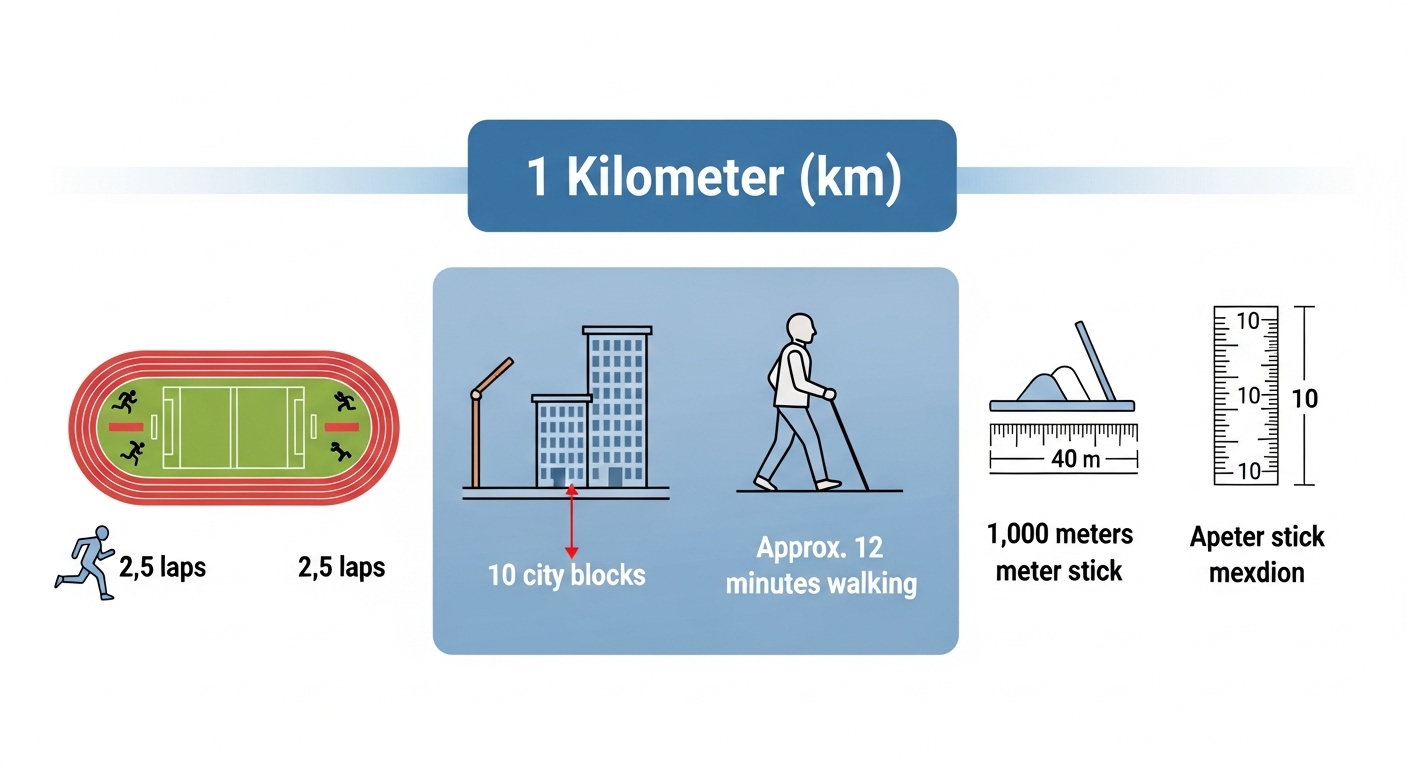
| Quick visual | ≈ 10 football fields, ≈ 16 school buses, ≈ 12-minute walk |
| Formula | meters = kilometers × 1,000; miles ≈ kilometers × 0.62 |
| Example | 5 km → 5,000 m ≈ 3.1 mi; 8 km → 8,000 m ≈ 4.96 mi |
| Usage | Running races (5K, marathon), hiking trails, road distances, city planning |
The Birth of a Kilometer: From Ancient Words to Modern Roads
So, the word kilometer actually comes from two Greek gems: khilioi, meaning “thousand”, and metron, meaning “measure”. Put ‘em together, and voila you’ve got “a thousand measures” (well, a thousand meters (m) to be precise).
This isn’t just trivia to win pub quizzes; it’s a peek into human curiosity, how we looked at the earth and thought: “hmm… let’s count this properly.”
Before the metric system was a thing, people were measuring distance in all sorts of ways footsteps, horse rides, rods, and even random sticks. Im
agine walking a marathon with a stick as your ruler. Today, with kilometers, we have a universal tongue for distance, whether you’re in Paris, Tokyo, or Johannesburg.
Conversions are fun too and kinda magical once you get them. One kilometer is 1,000 meters, which is handy if you love round numbers.
And for the mile-lovers out there: miles ≈ kilometers × 0.62. If you’re thinking backward, just divide miles by 0.62 and you’re there. For example, 3.5 mi 5.65 km. Pretty neat, right?
Understanding Distances in Everyday Life
Let’s get a lil playful. Saying “1 km” doesn’t mean much if you’ve never pictured it. So here’s some everyday slices of life:
- 1 km ≈ 10 football fields lined up end to end. Imagine your local stadium, times ten. Yeah, that’s a walk.
- 1 km ≈ a 10–12 minute walk at a chill pace. Perfect for coffee runs.
- 1 km ≈ 16 school buses parked nose-to-tail. Mind boggling, right?
- Running a 5 km race? That’s 5,000 m ≈ 3.1 mi. Feels shorter when you say 5K in a fun T-shirt, doesn’t it?
- Hikes often measure trails in km. An 8 km trail ≈ 4.96 mi, enough to stretch your legs and your lungs.
- Marathons are pure spectacle: 42.195 km → 42,195 m. That’s a lotta meters, a lotta sweat, a lotta stories.
So next time someone says “it’s 2 km away,” just imagine 20 football fields. Or, if you like buses, 32 of ‘em. Perspective matters.
Kilometer vs Mile: A Friendly Rivalry
Some countries live in miles, some in kilometers, and some are in that awkward “both” zone. The US is mostly miles, while Europe, Asia, and most of the world are firmly in kilometers.
The math is simple-ish once you get a handle on it:
- km mi: multiply by 0.62
- mi km: divide by 0.62
It’s like translating languages, except instead of “hello” or “hola”, you’re talking walking distances. For instance, an 8 km jog is roughly 4.96 mi almost five miles! Not bad for bragging rights.
Kilometers in Sports and Activities
Ever noticed races are often in kilometers? From the humble 5K to full-on marathons, the kilometer is the heartbeat of running. Why? It’s neat, easy to measure, and connects directly to the metric system.
- 5 km races: beginner-friendly, quick adrenaline hit.
- 10 km races: more stamina needed, heart racing.
- Half-marathons (21.1 km) and full marathons (42.195 km): legends only.
Even casual walks benefit. Tracking your steps? If you walk 1 km, that’s roughly 1,000 m, or maybe 1,300–1,500 steps depending on your stride. Little numbers adding up to huge adventures.
Kilometer Conversion Charts: Your Pocket Guide
Confusing numbers? Charts help. Seriously. A simple km m mi table can save you a mental headache.
| km | meters (m) | miles (mi) |
|---|---|---|
| 1 | 1,000 | 0.62 |
| 5 | 5,000 | 3.1 |
| 8 | 8,000 | 4.96 |
| 10 | 10,000 | 6.2 |
| 42.195 | 42,195 | 26.2 |
Visual learners rejoice. Step-by-step, +1 km = +1,000 m. Patterns emerge, numbers stick, and suddenly, math feels less like a punishment and more like a puzzle.
Historical and Cultural Tidbits About the Kilometer
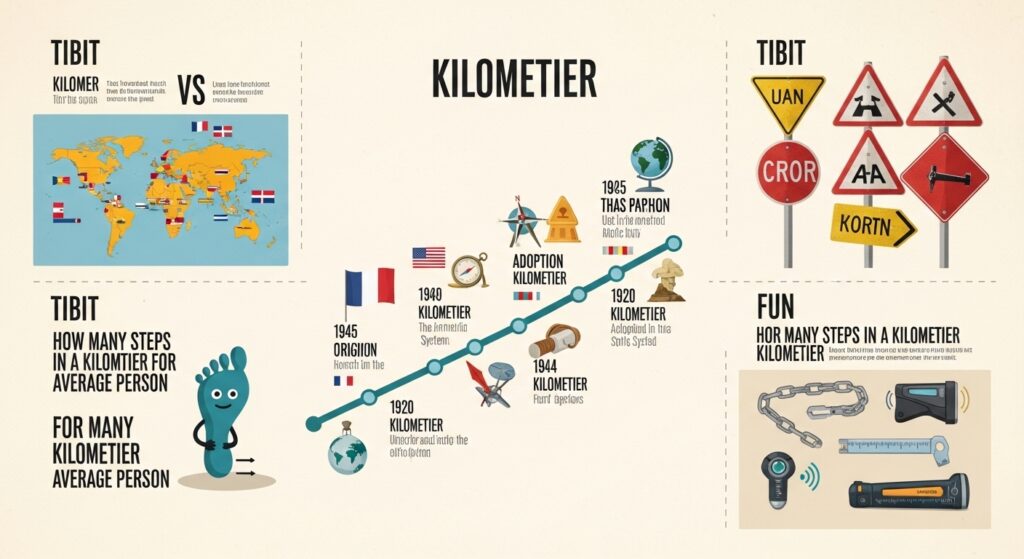
Did you know? Before kilometers were standard, France in 1799 tried to unify measurement across the nation.
They introduced the metric system, defining the meter based on the Earth’s meridian. Imagine that! Measuring a planet to standardize your morning jog.
Other ancient units existed too. The Romans had mille passus (thousand paces), roughly a mile. Funny how some old ideas sneak into modern units.
Across the globe, traditions vary some countries still cling to feet, inches, or their own quirky units.
And yet, kilometers slowly won hearts worldwide, probably because walking 1 km feels universal whether in the rain-soaked streets of London or the sunlit avenues of Tokyo.
Practical Uses of Kilometers in Daily Life
So why bother with kilometers beyond running races and charts? Life’s full of small journeys, and km helps measure, plan, and dream:
- Driving: Maps say 25 km to grandma’s place. You nod, grab snacks.
- Cycling: A casual 15 km ride is both exercise and mini-adventure.
- Hiking: Trails are measured in km. “Oh look, 8 km left, we got this.”
- City Planning: Roads, bridges, signs all km-based. Without it, urban life gets chaotic.
Even in schools, students practice converting km to m or mi to grasp real-world numbers. Mini quizzes, step-by-step guides, visual charts learning becomes alive.
How to Estimate Kilometers Without a Calculator
Sometimes life doesn’t hand you a calculator. Here’s a fun trick:
- If you know 1 mile ≈ 1.6 km, just double your miles and subtract a bit.
- A 3.5 mi run? Double 7, subtract tiny 1-ish 5.65 km. Close enough for a jog.
- Need walking perspective? 1 km ≈ 12 minutes. Just time yourself and multiply.
Patterns emerge. Numbers feel less scary. Math becomes a friendly companion rather than a math teacher screaming.
Making Kilometers Fun: Tips, Quizzes, and Adventures
Don’t let km feel dry. Turn it into a game, story, or challenge:
- Track your steps in meters and see how fast you cover 1 km.
- Convert your favorite marathon distances into miles challenge a friend.
- Use kilometer conversion charts as doodle art. Visual memory sticks.
- Estimate distances between places in your city guess in km, then check on the map.
It’s playful, practical, and sneaks learning into your everyday life.
Frequently Asked Questions
Why is the kilometer used worldwide?
Mostly because the metric system is neat, consistent, and universal. One rule fits all.
How long does it take to walk a kilometer?
Average stroll? 10–12 minutes. Running? 5–6 minutes. Sprinting? You wish!
Which countries don’t use kilometers?
US, Liberia, Myanmar primarily stick with miles. Everything else? Km is king.
How to estimate km to miles conversion?
Multiply km by 0.62 for miles. Divide miles by 0.62 for km. Quick, simple, nerdy-cool.
Read this blog: https://wittyeche.com/milliliters-to-grams/
kilometer meaning
A kilometer (km) is a unit of length in the metric system, equal to 1,000 meters. The word comes from Greek, meaning “thousand measures.”
is kilometers
Kilometers are units used to measure longer distances, such as roads, running races, or the space between towns.
what is 1 km
1 kilometer equals 1,000 meters, or about 0.62 miles.
how big is a kilometer
A kilometer is roughly the length of 10 football fields, a 10–12 minute walk, or 16 school buses placed end to end.
1 kilometer
1 kilometer is a standard metric distance used worldwide to measure distances between places, roads, and athletic events.
Conclusion: Why Kilometers Matter
At the end of the day, the kilometer isn’t just numbers on signs or a confusing stat on a fitness app. It’s a bridge between places, people, and stories.
From ancient Greek roots (khilioi + metron) to your morning jog, it quietly maps our lives. It’s universal, simple, and yet deeply personal every km walked, biked, or driven carries a memory, a laugh, or a small triumph.
So next time you see a sign: “5 km to the lake,” smile. That’s 5,000 m of potential, 3.1 miles of adventure, 10 football fields of stories waiting to be lived. And remember, every journey begins with a step sometimes measured, sometimes just felt.