

The first time I ever heard someone seriously argue about Length, Width, and Height, it was in a hospital corridor that smelled like disinfectant and overcooked tea.
A new baby girl had arrived, tiny, loud, perfect, and her grandfather was trying to measure the crib space with his hands because numbers felt too cold for the moment.
He said, “It’s long-ish, wide enough, and tall… well tall for a baby,” and everyone nodded like that was science. That moment stuck. Measurement, even when we don’t say it properly, is how we make sense of new things entering our world. Including ideas.
So if you’ve ever wondered what is length width height and why people argue about the order of dimensions (Length × Width × Height) like it’s family inheritance, you’re not alone, not even a little. This article is for students, parents, builders, bakers, curious minds, and anyone who’s ever stared at a box and thought, “which side are you, really?”
We’re going to talk definitions, examples, odd little truths, and yes, even feelings around measurement, because numbers don’t live in a vacuum. They live in rooms, containers, playgrounds, and sometimes in baby cribs measured by hands instead of rulers.
| Term | Simple Definition | Direction | Example | Common Units |
|---|---|---|---|---|
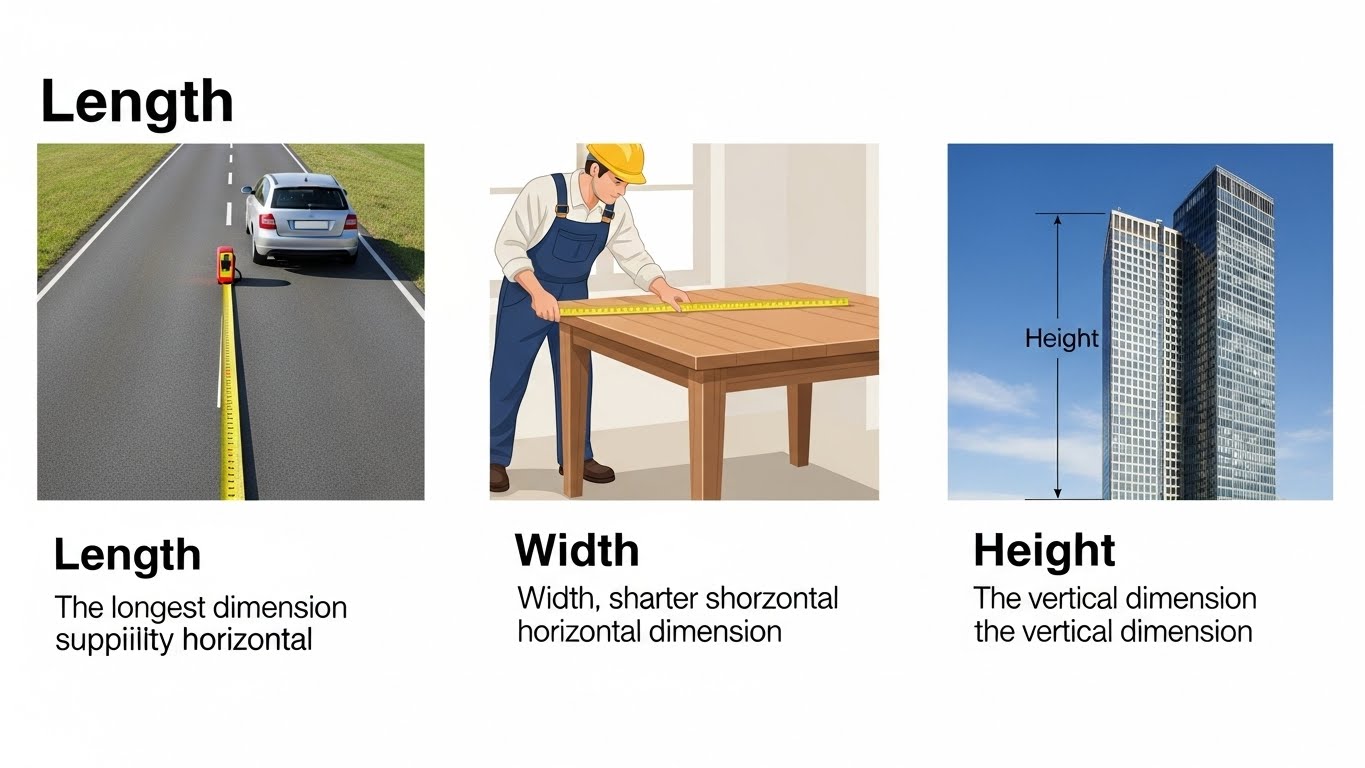
| Length | The longest measurement of an object | End-to-end (horizontal) | Length of a table or road | cm, m, km, inches, feet |
| Width | Measurement from side to side | Side-to-side (horizontal) | Width of a door or book | cm, m, inches, feet |
| Height | Measurement from bottom to top | Vertical | Height of a person or building | cm, m, feet |
| Depth | Measurement from front to back | Horizontal inward | Depth of a box or swimming pool | cm, m, inches |
| Length × Width | Used to find area | 2D measurement | Area of a rectangle | square cm, square m |
| Length × Width × Height | Used to find volume | 3D measurement | Volume of a box (cuboid) | cubic cm, cubic m |
Understanding Length, Width, and Height in Human Language

Let’s not be stiff about it. Length is usually the longest side, the end-to-end measurement that stretches out like a lazy cat in the sun. It’s the dimension that says, “I go this way,” and expects you to follow. In math books, Length vs width is explained with straight faces, but in real life, length is the side your eyes naturally track first.
Width is the side-to-side measurement, the quiet companion. It runs perpendicular to length, like it doesn’t want attention but fully deserves it. When people ask about the difference between length and width, what they’re really asking is why one feels dominant. Width can sometimes be longer than length, yes, and that messes with people’s heads more than it should.
Height is the vertical measurement, the one that defies gravity a little. Floor to top. Bottom to sky. This is where height vs width length measurement confusion often sneaks in, because height only makes sense when something is standing up. Lay it down and suddenly height disappears into something else, maybe depth, maybe not.
And then there’s Depth, often mistaken as height’s twin. Depth is how far something goes inward, front to back. Is length the same as depth? No, not really, though in some sneaky contexts they borrow each other’s coats.
All of these together are called Dimensions, and without them the world would be a blurry suggestion.
Length Width Height Definition With Real Examples That Feel Real
Imagine an A4 sheet of paper resting on your desk. Its A4 paper dimensions are a classic example of 2D shapes, specifically a Rectangle. It has Length and Width, no height worth mentioning unless you stack a thousand of them and call it art. The Area = Length × Width, and suddenly that flat paper feels mathematical.
Now take a Rectangular prism, also known as a Cuboid. A shoebox maybe, or a cereal box that’s been opened and closed too many times. This is where 3D shapes show off. It has length, width, and height, all perpendicular dimensions, all pretending they’re independent but secretly working together.
A Rectangular room is another honest example. The end-to-end wall is length. The side wall is width. Floor to ceiling is height. You don’t argue with a room, it just exists, measured or not.
And then there’s the Sphere, rebellious and smooth, refusing corners. No length or width in the usual way, only Radius and Diameter, and its Volume of sphere = 4/3 πr³, which feels like magic the first time you see it and still kinda does later.
Length Width Height Order and Why It Matters More Than You Think
People ask all the time, What is the order of length width height? and you can almost hear anxiety in the question. The standard length width height order is exactly that: Length × Width × Height, often written as L × W × H. This order matters in packaging, shipping, construction, and manufacturing, where mixing it up can cost real money and real embarrassment.
Imagine ordering a custom box for a gift and swapping width and height. Suddenly it doesn’t open right, or worse, doesn’t fit at all. The accuracy in measurement isn’t just about numbers being right, it’s about context being respected.
In math class, teachers repeat this order like a chant. In life, you remember it when something doesn’t fit through a door that you swore it would.
Measuring Length Width Height Using Tools That Exist
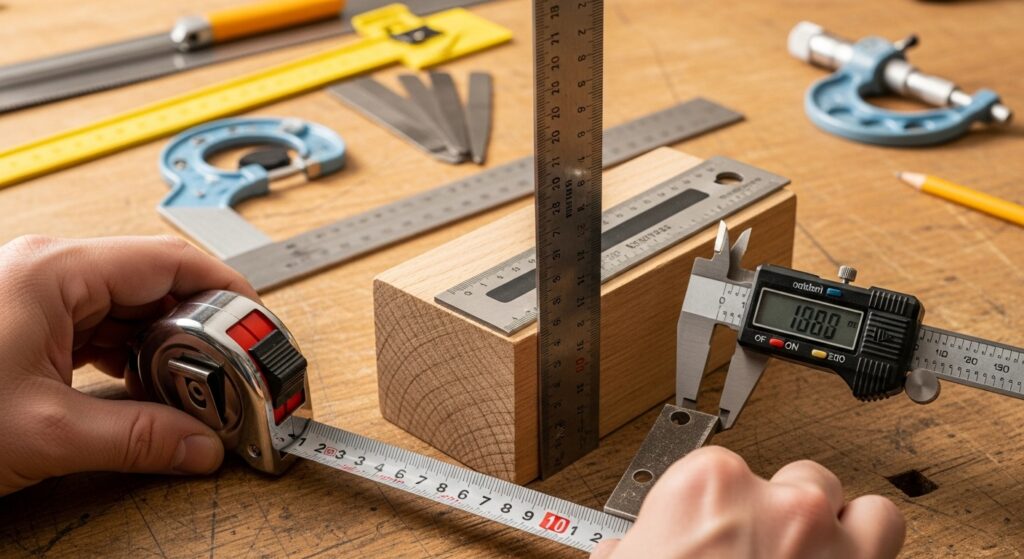
You don’t measure the world with vibes, sadly. You use measurement tools. A Ruler is the gateway tool, simple, straight, unforgiving. A Tape measure is more flexible, literally and emotionally, especially in construction sites or sewing rooms. A Laser distance measurer feels like cheating until you realize it’s just very confident light.
The trick in measuring dimensions accurately is consistency. Same units, same reference points, same calm energy. This is where units of measurement step in quietly.
In the Metric System, you’ll see Millimeters (mm) for tiny things, Centimeters (cm) for hand-sized things, Meters (m) for rooms, and Kilometers (km) for distances that make you sigh. Volume brings Cubic centimeters (cm³) and Cubic meters (m³) into play.
The Imperial System uses Inches, Feet, Yards, and Miles, with Square inches and Cubic inches showing up when area and volume want attention. Neither system is wrong, they’re just raised differently.
Length Width Height Formula and the Quiet Power of Volume
When all three dimensions meet, something solid happens. Volume = Length × Width × Height (L × W × H) is one of those formulas that feels almost too neat for real life, but it works. The Volume of cuboid or Volume of rectangular box tells you how much space something occupies, not how it looks, not how it feels, just how much room it takes.
Think of containers in a kitchen. A flour jar, a spice box, a cake tin. Their capacity depends on volume, not surface area. This matters in cooking, where a little mis-measurement turns bread into a brick.
Surface Area = 2 × (L × W + L × H + W × H) is the other side of the story. It tells you how much wrapping paper you need, how much paint covers a wall, or how much heat escapes a metal box in a science experiment.
Volume is about inside life. Surface area is about skin.
2D vs 3D Shapes and the Confusion That Teaches Us
The jump from 2D vs 3D is where many learners stumble, and that’s okay. 2D shapes like squares and rectangles live on paper, flat and honest. They deal with Area and Perimeter, with Area = Length × Width being the star equation.
3D shapes add complexity. A Cylinder has a Base, a height, and curves that don’t behave. Its Volume of cylinder = πr² × h, where r is radius and h is height, and suddenly circles are doing heavy lifting.
TV screens and Computer monitors are fun hybrids in discussion. We talk about their size diagonally, which ignores length and width directly, just to confuse everyone equally.
Real-World Measurement Stories That Stick
A civil engineer once said, “I trust my tape measure more than my memory,” and that stuck with me. In engineering, a few millimeters off can change load distribution, safety, everything. In manufacturing, a wrong breadth or width means parts don’t assemble, and machines sit idle, sulking.
In schools, Grade 1 measurement starts with hands, steps, and blocks. Kids measure desks with pencils and call it learning. Later, Math worksheets, Surface area worksheets, and Volume worksheets formalize that curiosity. Somewhere in between, numbers stop being scary.
Platforms like Brighterly and modern math tutors now offer interactive math learning, personalized lessons, and even a free math lesson here and there, because understanding dimensions shouldn’t feel like punishment.
Length vs Width vs Height Questions People Whisper

Can width be longer than length? Yes, and the universe doesn’t collapse when it happens.
Is length the same as depth? Not usually, but context is a slippery thing.
How do you calculate volume? You multiply dimensions, gently, respectfully.
What units are used for measurement? The ones everyone agrees on, or argues about, depending on the room.
How to find missing dimensions? You rearrange formulas, breathe, and trust algebra a little more than yesterday.
These aren’t just math problems, they’re thinking problems.
Practice, Examples, and Learning That Feels Personal
A Brick dimensions example helps builders. A Door dimensions example helps movers. Playground dimensions matter to kids who want swings spaced just right. Box dimensions matter to online sellers hoping returns don’t eat profits.
Solved examples aren’t about answers, they’re about patterns. Worksheets aren’t about repetition, they’re about confidence sneaking in quietly.
A parent once said, “When my daughter understood why her toy box overflowed, she understood volume,” and honestly, that’s better than any textbook quote.
Read this Blog: https://wittyeche.com/half-of-3-4/
Frequently Asked Questions
length and width
Length is the longest measurement of an object from one end to the other, while width measures the distance from side to side.
difference between length and width
Length usually represents the longer side of an object, whereas width is the shorter side measured perpendicular to the length.
length x width
Length × width is used to calculate the area of a flat shape such as a rectangle or square.
length and width, and height
Length, width, and height are the three dimensions of a 3D object, and multiplying them gives the volume.
width and length
Width shows how wide an object is from side to side, while length shows how long it is from end to end.
A Gentle Conclusion With Practical Advice
Understanding Length Width Height isn’t about memorizing formulas and moving on. It’s about seeing the world as measurable but still magical. When you write a custom message in a birthday card, you consider space. When you pack a gift, you think in dimensions. When you rearrange a room, you’re doing geometry with feelings.
If you want to make measurement stick, tie it to real life. Measure your table. Guess first, then check. Use the wrong unit once and feel why it matters. Teach kids with snacks, not just rulers.
And if you’ve got a favorite way of explaining dimensions of 3D objects, or a story about a measurement gone wrong or surprisingly right, share it. Learning grows when stories do.
In the end, welcoming a new idea is a bit like welcoming a baby girl into the world. You don’t know all her dimensions yet, but you know she’ll take up space, and that space will matter.